




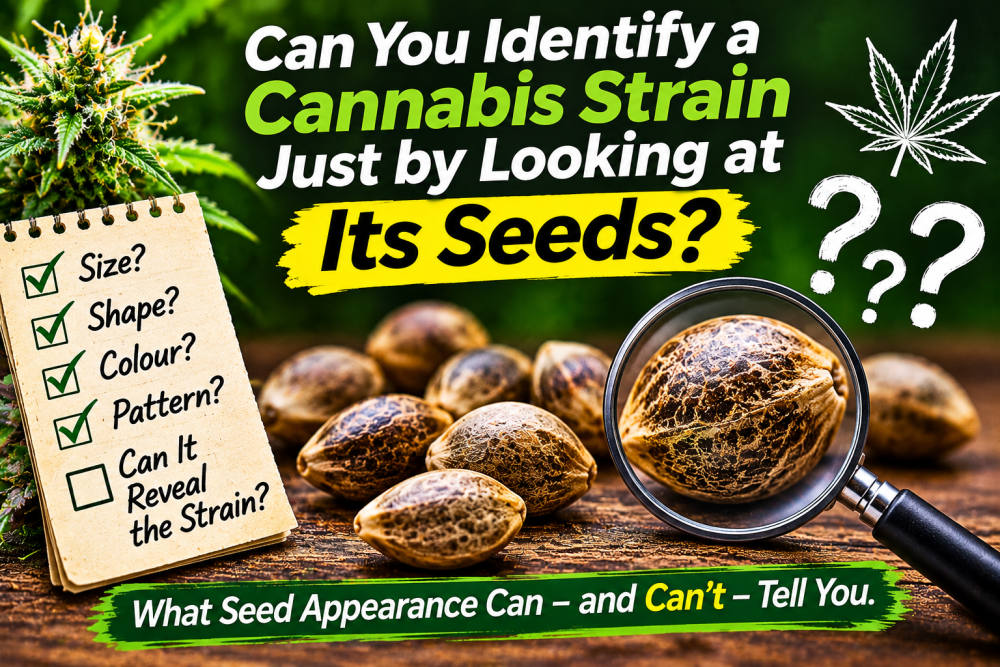
Cannabis Seeds: Can You Identify a Cannabis Strain Just by Looking at Its Seeds?
By Molly. Discount Cannabis Seeds.
Cannabis seeds come in different colours, sizes, shapes and patterns. Some are pale brown, others are dark grey, and many have distinctive markings across their outer shells.
But can you actually identify a cannabis strain simply by looking at its seeds?
It's an interesting question, particularly when comparing cannabis seeds from different breeders or examining varieties within a collection.
A dark, heavily patterned seed might look completely different from a smaller, lighter seed. It's easy to assume that these differences reveal something about the genetics inside.
However, the scientific explanation is more complicated.
The short answer is no. You cannot reliably identify a specific cannabis strain from the appearance of its seeds alone.
Although seed characteristics can provide some information about development and physical condition, they do not offer a reliable visual fingerprint of a named cannabis variety.
Understanding why reveals some fascinating facts about cannabis genetics, plant biology and the limitations of visual identification.
Why Do Cannabis Seeds Look Different?
Cannabis seeds are botanical structures designed to protect a developing embryo.
Each seed contains an embryo, stored nutritional reserves and a protective outer covering known as the seed coat, or testa.
- The seed coat is responsible for much of the colour and pattern visible on the outside.
- Cannabis seeds can vary in several noticeable ways.
- Colour, including pale tan, brown, grey and darker shades.
- Surface markings, including mottled, striped or marbled patterns.
- Overall size and weight.
- Shape, including slightly rounder or more elongated forms.
- Surface texture and appearance.
These characteristics are influenced by genetics, development and environmental conditions during seed formation.
However, none of these features is unique enough to identify a particular commercial cannabis strain with confidence.
Two seeds with different appearances may belong to the same named variety.
Equally, two seeds that look almost identical may have very different genetic backgrounds.
What Causes the Tiger Stripes on Cannabis Seeds?
One of the most recognisable features of cannabis seeds is their patterned outer shell.
Collectors often describe these markings as tiger stripes or marbling.
The patterns are associated with the structure and pigmentation of the seed coat.
Differences in pigmentation and the arrangement of seed-coat tissues contribute to the mottled appearance seen on many cannabis seeds.
However, these markings are not exclusive to individual cannabis strains.
A seed with prominent stripes is not automatically a particular variety, and a seed without obvious stripes is not necessarily genetically different from another seed in the same collection.
The visibility of these markings can also change when the seed surface is handled or its outermost layers are affected.
This means that the appearance of the markings is not a dependable genetic identification method.
Does Seed Colour Tell You Which Cannabis Strain It Is?
Seed colour can provide some information about the physical appearance and development of a seed, but it cannot reliably identify its strain.
Cannabis seeds may appear tan, brown, grey or almost black.
Some have contrasting patterns, while others appear relatively uniform.
The colour of the outer shell is influenced by pigmentation, seed development and the condition of the seed coat.
It is sometimes claimed that darker cannabis seeds belong to stronger or more desirable varieties.
There is no reliable scientific basis for identifying a strain's potency or cannabinoid profile from seed colour alone.
The compounds and characteristics associated with mature cannabis plants cannot be determined simply by examining the colour of a dry seed.
A darker seed is not automatically superior to a lighter one.
Likewise, a pale seed cannot be assigned to a particular genetic family based on its colour.
Can Cannabis Seed Size Reveal Its Genetics?
- Cannabis seeds can vary considerably in size.
- Some are relatively small and compact, while others are larger and more rounded.
- Genetic background can contribute to differences in seed dimensions.
- However, seed size is also affected by conditions during development, including the resources available to the parent plant.
- Variation can occur even among seeds produced by the same parent plant.
This is important because a named commercial cannabis strain does not necessarily produce seeds of one identical size.
A packet containing seeds of slightly different dimensions is not, by itself, evidence that the seeds belong to different strains.
Similarly, two seeds of identical size do not necessarily share the same genetic ancestry.
Seed measurements may be useful in scientific studies involving populations, but they are not sufficiently specific to authenticate an individual commercial variety.
Can You Tell Whether a Cannabis Seed Is Feminised or Regular by Looking at It?
No.
This is one of the most common misconceptions about cannabis seed identification.
Feminised and regular cannabis seeds cannot be reliably distinguished by their external appearance.
The difference between these product categories concerns the breeding process and the expected sex characteristics of the resulting plants.
It is not represented by a distinctive shell colour, shape or pattern that can be identified visually.
A feminised cannabis seed may look almost identical to a regular cannabis seed.
Claims that one category can be identified by a particular stripe, indentation or shell shape are not supported by reliable scientific evidence.
For collectors, the product's breeder documentation and original identification are therefore more meaningful than visual assumptions.
Can You Identify Auto Flower Cannabis Seeds by Their Appearance?
Auto flower cannabis seeds are another category that cannot be reliably identified by appearance alone.
Auto flower characteristics are associated with inherited genetic factors affecting flowering behaviour.
These characteristics are not expressed as a distinctive external seed pattern.
An auto flower seed can look very similar to a photoperiod seed.
There is no dependable visual test that allows someone to identify an auto flower variety simply by examining its size, colour or shape.
This is why accurate labelling is important when distinguishing different cannabis seed categories.
At Discount Cannabis Seeds, our collections include both auto flower and photoperiod varieties, with products identified according to their commercial classifications.
You can explore our exclusive Discount Cannabis Seeds cannabis seed collection.
Why Two Seeds From the Same Strain Can Look Different.
It might seem reasonable to expect every seed from a named variety to look identical.
However, biological variation means this is not necessarily the case.
Even seeds produced within the same breeding population can differ in size, colour and surface markings.
Several factors contribute to these differences.
Genetic Variation.
Seeds produced through sexual reproduction can inherit different combinations of genetic material.
The degree of variation depends on the parental genetics and breeding history.
Seed Development.
Differences in development can affect seed dimensions, pigmentation and other physical characteristics.
Environmental Conditions.
Conditions experienced by the parent plant during seed formation can influence seed size and other physical properties.
Seed-Coat Characteristics.
Differences in the appearance of the seed coat can make seeds look more or less heavily patterned.
These factors explain why visual variation does not automatically indicate that seeds have been mixed or incorrectly identified.
Can Two Completely Different Cannabis Strains Produce Identical-Looking Seeds?
Yes.
Different cannabis varieties can produce seeds with remarkably similar external characteristics.
This is because seed appearance is not a unique representation of the complete genetic information contained within the embryo.
Two genetically different seeds may share similar pigmentation, dimensions and surface patterns.
The reverse is also possible.
Seeds with related genetic backgrounds may display noticeable differences in appearance.
This creates a fundamental problem for visual identification.
If several unrelated varieties can produce seeds with the same visible features, those features cannot reliably identify one specific strain.
What About Identifying Cannabis Seeds Under a Microscope?
A microscope can reveal details that are difficult to see with the naked eye.
These may include the structure of the seed coat, surface texture and other morphological characteristics.
Such observations can be useful in botanical research.
However, microscopy does not automatically provide a reliable method for distinguishing commercial cannabis strains.
A microscope cannot reveal a named variety's complete genetic identity simply from the appearance of its seed coat.
Even highly detailed images may show characteristics shared by numerous varieties.
Microscopy can therefore provide additional physical information without establishing a definitive strain identification.
Can DNA Testing Identify a Cannabis Strain?
DNA analysis provides a more scientifically meaningful way to investigate genetic relationships than visual inspection.
Researchers can examine genetic markers to compare samples and assess relatedness.
This may help distinguish particular genetic lines or identify differences between samples.
However, cannabis strain identification presents several challenges.
Commercial strain names are not always associated with one genetically uniform population.
Different breeders may use the same name for products with different genetic backgrounds.
Genetic variation may also exist within a named variety.
For these reasons, DNA testing does not automatically produce a universally accepted commercial strain name.
Reliable identification depends on the quality of the genetic reference data, the testing methods and the availability of authenticated comparison samples.
A genetic test may establish that two samples are closely related without proving that either represents the original version of a historically named strain.
This is an important distinction between genetic analysis and commercial product identification.
Can You Tell Whether a Cannabis Seed Is Healthy Just by Looking at It?
Visual inspection can reveal some obvious physical problems.
For example, a seed may have a visibly cracked shell, extensive physical damage or signs of mould.
These observations can be useful when assessing its external condition.
However, appearance alone cannot establish whether a seed is viable.
A seed that looks intact may no longer be viable.
Another seed with an unusual colour or less prominent markings may still be viable.
Scientific assessments of seed viability involve methods that go beyond simply examining external colour and pattern.
This is why claims that all dark seeds are healthy or all pale seeds are unsuitable should be treated cautiously.
Appearance provides limited information rather than a definitive assessment.
Why Original Packaging and Breeder Information Matter.
Because visual identification is unreliable, accurate product records play an important role in cannabis seed collecting.
Original packaging can provide information such as the breeder's name, commercial variety, seed category and pack quantity.
Some breeders also provide batch identifiers or additional product information.
These details help establish how a product was originally represented.
However, packaging is not equivalent to independent genetic verification.
A packet can identify the commercial product being sold without proving that its contents are genetically identical to a particular historical selection.
For collectors researching the origins of a variety, breeder documentation and traceable product information are more useful than assumptions based on seed appearance.
You can browse the international cannabis seed breeders available at Discount Cannabis Seeds.
Common Myths About Identifying Cannabis Seeds.
Common claim.
What the evidence supports.
Dark seeds are always stronger.
Seed colour does not reliably predict potency or cannabinoid content.
Tiger stripes identify a particular strain.
Similar patterns occur across different genetic backgrounds.
Feminised seeds have a different shape.
Feminised and regular seeds cannot be reliably distinguished visually.
Auto flower seeds are smaller.
Size alone cannot establish whether a seed is auto flower or photoperiod.
Every seed from one strain should look identical.
Natural variation can occur within the same breeding population.
A microscope can reveal the exact strain.
Microscopy may reveal physical characteristics but does not establish commercial strain identity.
DNA testing always reveals the original strain name.
Genetic testing requires suitable reference data and cannot resolve every commercial naming dispute.
What I've Learned About Cannabis Seed Identification Since 2010.
Having run Discount Cannabis Seeds since 2010, I've seen how much attention customers give to the names, descriptions and appearance of different cannabis seed products.
It's understandable that collectors want to know exactly what they're purchasing.
However, the appearance of an individual seed cannot tell the whole story.
A seed's colour or pattern does not reveal its breeder, its full genetic ancestry or whether it belongs to a particular commercial variety.
This is why I believe clear product identification matters.
At Discount Cannabis Seeds, we offer original international breeder products alongside our exclusive DCS cannabis seed collection.
These are presented as separate commercial collections so customers can identify the products they are browsing.
We don't claim that cannabis genetics can be authenticated simply by looking at the seeds.
Instead, product names, breeder information and available descriptions provide the context needed to understand each collection.
Visit Discount Cannabis Seeds to explore our current range of cannabis seeds.
Conclusion. A Cannabis Seed Cannot Reveal Its Entire Genetic Identity.
Cannabis seeds may look simple, but they contain complex genetic information that cannot be interpreted reliably from their outer appearance.
Colour, size, shape and surface patterns can vary for several reasons.
Some differences are associated with genetics, while others reflect seed development and environmental influences.
None of these visible characteristics provides a dependable method for identifying a specific commercial cannabis strain.
The same limitation applies to distinguishing feminised, regular and auto flower cannabis seeds.
Although microscopy and genetic testing can provide additional scientific information, identifying a named commercial variety requires suitable records and reliable reference material.
For collectors, the most useful approach is to look beyond the appearance of the seed.
Understanding breeder information, genetic history and product identification provides a much clearer picture than relying on colour or tiger stripes.
And that's what makes cannabis genetics such an interesting subject to explore.
About the Author. Molly at Discount Cannabis Seeds.
Molly is the owner of Discount Cannabis Seeds, an independent UK cannabis seed retailer established in 2010.
She manages the day-to-day running of the business, including customer enquiries, order management, product information and breeder collections.
Through the Discount Cannabis Seeds blog, Molly shares educational articles about cannabis seed genetics, breeder history and the science behind the varieties found in modern catalogues.
Discount Cannabis Seeds offers original international breeder products alongside its exclusive DCS cannabis seed collection.
We ship worldwide to eligible destinations, subject to applicable laws, customs requirements and delivery restrictions.
Legal Information.
Cannabis seeds themselves are generally excluded from the definition of controlled cannabis under UK drug legislation.
However, cultivating cannabis without the necessary authorisation remains illegal under the Misuse of Drugs Act 1971.
International laws concerning cannabis seeds vary, and customers are responsible for ensuring that purchasing, possessing and importing them complies with applicable regulations.