




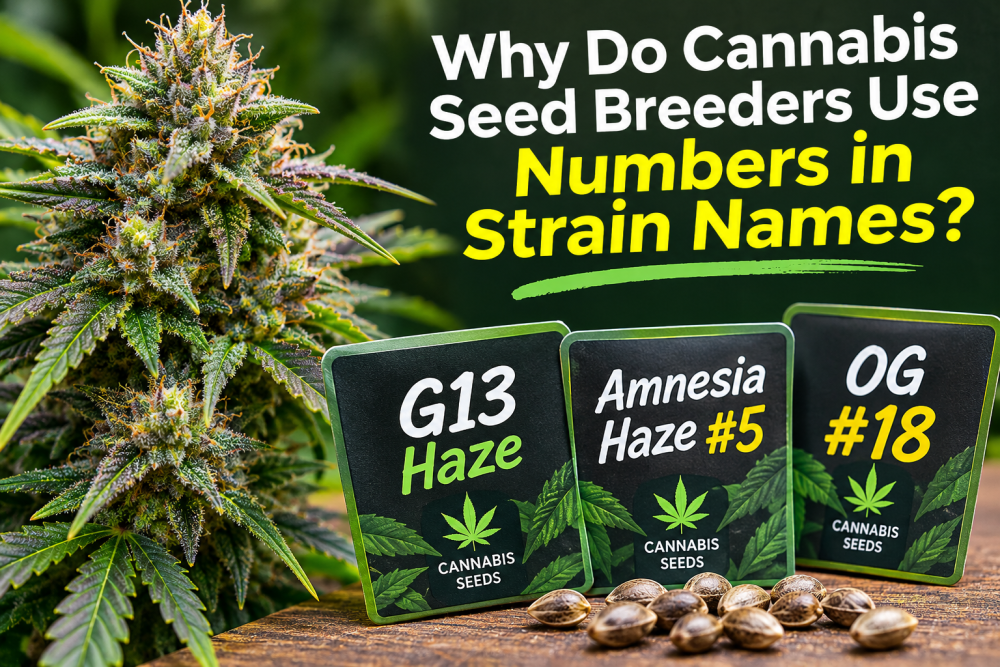
Cannabis Seeds: Why Do Cannabis Seed Breeders Use Numbers in Strain Names?
If you've ever browsed a cannabis seeds catalogue, you may have wondered why some varieties have numbers attached to their names.
Northern Lights #5, Skunk #1 and Gorilla Glue #4 are three recognisable examples.
At first glance, those numbers might look like rankings, strength ratings or different versions of the same product.
But their meanings are often much more interesting.
Some numbers originated as identifiers for individual plants or genetic selections. Others became part of a recognised breeding line's name, while certain numbering systems developed through decades of cannabis breeding history.
Understanding these names offers a glimpse into how breeders have identified, recorded and distinguished cannabis genetics over time.
The Number Is Usually an Identifier, Not a Rating.
One of the most common misunderstandings is that a higher number means a stronger or better cannabis variety.
That is not how these names generally work.
A number may originally have been used to distinguish one selection from another during a breeding project.
For example, a breeder might identify several different plants using numbers rather than giving each one a separate commercial name.
- If one selection later becomes particularly well known, its original number may remain attached to the variety.
- Over time, that practical identifier can become part of its permanent commercial identity.
- The important distinction is that numbering systems are not universal.
- A number used by one breeder may have an entirely different meaning from a number used by another.
Northern Lights #5. A Number With a Long History.
Northern Lights is one of the most influential genetic families in cannabis breeding history.
Its early development is associated with the United States before Northern Lights genetics became established within the Dutch seed industry.
Historical accounts describe several numbered Northern Lights selections.
Sensi Seeds has documented how numbered Northern Lights material reached the Netherlands and contributed to the development of its early catalogue.
Northern Lights #5 became particularly recognisable.
The number identifies a historic selection associated with the wider Northern Lights family rather than indicating that the variety is five times stronger or superior to another version.
One of its most notable appearances was in Northern Lights #5 x Haze, a variety introduced commercially in 1989.
The continued recognition of Northern Lights #5 demonstrates how a simple selection identifier can become part of cannabis breeding history.
Gorilla Glue #4. When a Selection Number Became Famous.
Gorilla Glue #4 provides a more recent example.
The original American variety became associated with the breeders behind GG Strains and was later widely recognised under the shortened name GG4.
The number four was associated with a particular selection.
As the variety became more widely recognised, that numbered identity remained part of its name.
In a 2017 interview published by Cannabis Business Times, representatives connected with GG Strains discussed how the variety's original selection number became part of its identity.
The commercial name also changed following a trademark dispute involving the Gorilla Glue adhesive brand.
Gorilla Glue #4 subsequently became known as GG4 or Original Glue.
This history is interesting because the number survived changes to the surrounding commercial name.
Today, different breeders may offer cannabis seed products associated with the Gorilla Glue genetic family.
However, a packet labelled GG4 does not automatically prove that its contents are genetically identical to the original selection.
Skunk #1. A Number That Became Part of a Classic Name.
Skunk #1 is another important name in cannabis history.
The variety is associated with the development of influential American cannabis genetics during the 1970s and their subsequent introduction to Europe.
Skunk #1 became recognised as a particular breeding line, rather than simply a generic reference to every variety containing Skunk genetics.
Its name has appeared in historical breeder records and seed catalogues for decades.
Unlike a clearly documented individual plant selection such as GG4, the precise original reasoning behind the number in Skunk #1 is less straightforward to establish from publicly available historical accounts.
It would therefore be misleading to claim with certainty that the number represented a specific numbered plant without supporting documentation.
What is clear is that Skunk #1 became an established variety name in its own right.
The number is now part of how that historic genetic line is identified.
Not Every Number Means the Same Thing.
The examples above demonstrate why numbered strain names need to be interpreted individually.
A number might refer to a selected plant, a historic genetic line or an identifier that became established through commercial use.
There is no single international rule governing every numbered cannabis variety.
This is especially important when looking at names that appear similar.
A variety ending in #4 is not necessarily the fourth commercial release from its breeder.
A variety ending in #1 is not automatically the first cannabis strain ever developed.
And a larger number does not establish a higher level of quality.
The meaning depends on the specific history of the product.
What Is the Difference Between a Numbered Selection and a Breeding Generation?
Numbers also appear in technical breeding terminology, but these should not be confused with numbered strain names.
For example, labels such as F1, F2 and BX1 can describe aspects of a breeding programme.
An F1 designation generally refers to a first filial generation produced from a parental cross.
An F2 designation refers to the following filial generation.
BX1 is commonly used to describe a first backcross generation, although breeders may use slightly different naming conventions.
These labels describe breeding relationships rather than serving as ordinary strain nicknames.
By comparison, the number in Gorilla Glue #4 is associated with a particular selection.
The number in Northern Lights #5 has its own historical context.
Understanding the difference helps prevent confusion when researching breeder catalogues.
Why Do Breeders Keep the Numbers Instead of Creating New Names?
Once a numbered selection becomes recognised, changing its name can create confusion.
Historical records, breeder descriptions and later genetic references may all use the original designation.
Keeping the number helps preserve that connection.
It can also distinguish a recognised selection from the wider genetic family.
For example, Northern Lights is a broad name associated with several historical lines.
Northern Lights #5 identifies a more specific selection within that history.
Similarly, GG4 became a recognisable identity associated with the original Gorilla Glue #4 selection.
In these situations, the number has become part of the variety's story.
Can Two Breeders Sell Seeds With the Same Numbered Name?
Yes.
A well-known numbered variety may eventually appear in several commercial catalogues.
However, the presence of the same number does not guarantee identical genetic material.
One breeder may work with descendants of a particular selection.
Another may develop a separate seed line associated with the same recognised name.
A third may use the historic variety as part of a newer hybrid.
This is why the identity of the breeder remains important.
The name on a packet provides a starting point, but it does not independently establish the product's precise ancestry.
Where available, original breeder documentation can help clarify the relationship.
Why Numbered Strain Names Interest Cannabis Seed Collectors.
For collectors interested in cannabis history, numbered names can provide useful clues.
They may point towards an older breeding programme, a particular selection or an influential genetic family.
They can also make historical research more interesting.
For example, researching Northern Lights #5 leads into the early relationship between American and Dutch cannabis breeding.
Looking into GG4 reveals the development of a modern American selection and the commercial naming changes that followed.
Skunk #1 introduces a much earlier chapter involving the development of hybrid cannabis genetics.
Each number has a different story behind it.
And in many cases, that story is more interesting than the number itself.
Understanding Numbered Cannabis Strains at Discount Cannabis Seeds.
Discount Cannabis Seeds has been trading since 2010, and over the years we've seen how established genetic names continue to influence modern breeder catalogues.
Our collections include historic varieties, contemporary hybrids and exclusive DCS cannabis seeds.
When looking at a product with a numbered name, we believe it's useful to understand the difference between the original historical selection and later commercial seed versions.
A recognisable name is not a substitute for accurate breeder information.
Our cannabis seed breeder directory brings together collections from different international breeders.
We also offer our own exclusive Discount Cannabis Seeds collection.
The aim is to provide clear product identification while recognising that some cannabis genetic histories are more thoroughly documented than others.
Three Numbered Cannabis Strains and What Their Names Tell Us.
Cannabis strain.
Meaning or historical significance.
A recognised numbered selection associated with the historic Northern Lights genetic family.
A particular American selection that became widely known as GG4 and Original Glue.
An established historic breeding-line name whose precise original numbering rationale is not conclusively documented here.
These examples illustrate three different naming histories rather than one universal numbering system.
Conclusion. The Stories Behind the Numbers.
Numbers in cannabis strain names are not simply decorative additions.
They can preserve information about historic selections, breeding projects and the development of recognised genetic lines.
Northern Lights #5 connects modern catalogues with an influential period in Dutch and American cannabis history.
Gorilla Glue #4 shows how a numbered selection can become internationally recognised.
Skunk #1 demonstrates how a numerical designation can become inseparable from the identity of a classic variety.
The next time you see a number attached to a cannabis strain name, it's worth asking what that number originally represented.
It may be a small detail on the packet, but it could point towards decades of breeding history.
About the Author. Molly at Discount Cannabis Seeds.
Molly is the owner of Discount Cannabis Seeds, an independent UK cannabis seed retailer established in 2010.
She is involved in the daily running of the business, including customer enquiries, product information, breeder collections and order management.
Through the Discount Cannabis Seeds blog, Molly shares accessible articles about cannabis genetics, breeder histories and the terminology found in modern seed catalogues.
Discount Cannabis Seeds ships worldwide to eligible destinations, subject to applicable laws, customs requirements and delivery restrictions.
Legal Information.
Cannabis seeds themselves are generally excluded from the definition of controlled cannabis under UK drug legislation.
However, cultivating cannabis without the necessary authorisation remains illegal under the Misuse of Drugs Act 1971.
International laws concerning cannabis seeds vary, and customers are responsible for ensuring that purchasing, possessing and importing them complies with applicable regulations.
This article is provided for educational purposes and does not constitute legal advice.