




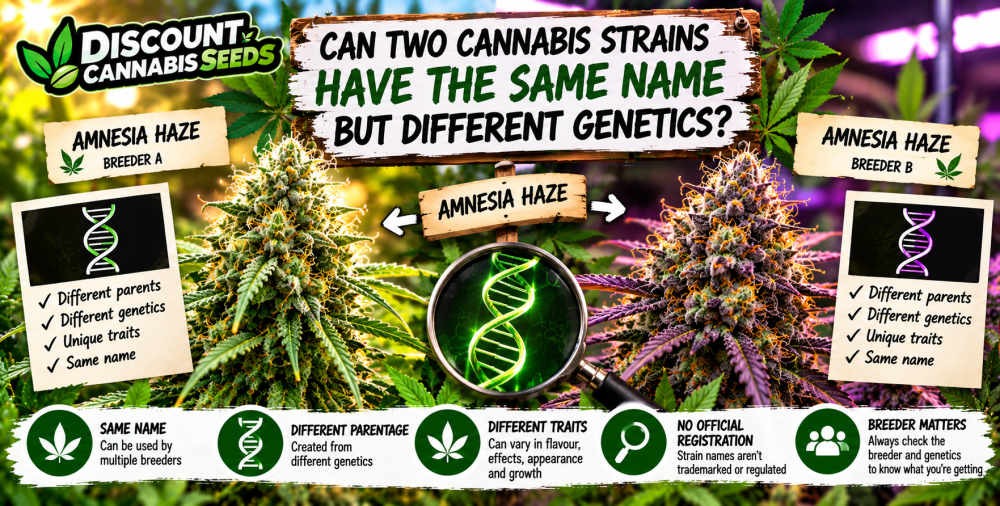
Cannabis Seeds: Can Two Cannabis Strains Have the Same Name but Different Genetics?
Yes. Two cannabis strains can share exactly the same name while having different genetics, different parent strains or coming from completely different breeders. Cannabis strain names are not governed by one worldwide naming authority, so a familiar name alone does not guarantee that two cannabis seeds products are genetically identical.
This is one of the reasons the breeder name and stated genetic lineage are so important when comparing cannabis seeds.
A strain name might be famous, but the story behind that name can be much more complicated.
Why Can Different Cannabis Strains Have the Same Name?
Unlike some agricultural crops, there isn't one global organisation assigning and controlling every cannabis strain name.
For much of cannabis breeding history, genetics were developed in an underground or semi-underground industry. Breeders exchanged genetics internationally, records weren't always public, and strain names could spread long before there was an easy way to establish who was using them.
The modern cannabis seed industry is far more organised, but the naming legacy remains.
One breeder can therefore have a strain with a particular name while another breeder offers a strain carrying the same name but with a different reported lineage.
That's why strain name doesn't necessarily equal genetic identity.
Does a Cannabis Strain Name Tell You Its Exact Genetics?
Not necessarily.
A name is best thought of as an identifier rather than a complete genetic description.
Sometimes the connection is extremely clear because the breeder provides the parent genetics and history behind the strain.
Other times, a famous strain name has been used for decades and has become associated with numerous different selections and breeder interpretations.
The older and more famous a name becomes, the more complicated its history can become.
This is particularly noticeable with classic names that have travelled between countries and breeders over several decades.
Why Is the Breeder Name So Important?
Consider these two imaginary products:
Breeder A – Midnight Cake
and
Breeder B – Midnight Cake
At first glance, they appear to be the same cannabis strain.
But suppose Breeder A describes Midnight Cake as:
Wedding Cake × Purple Punch
while Breeder B describes its Midnight Cake as:
Gelato × Black Cherry Punch
The strain name is identical.
The stated genetics are completely different.
That's why somebody researching cannabis seeds shouldn't search only for the strain name.
The more useful identifier is:
Breeder + Strain Name + Lineage
Together, those pieces of information provide much more context.
How Can Two Breeders Accidentally Choose the Same Name?
Consider how many cannabis strains now exist internationally.
Breeders are creating new crosses in Europe, North America and elsewhere, and many are independently trying to create memorable names.
Words relating to fruit, sweets, colours, desserts, fuel, animals, places and popular culture appear repeatedly.
It isn't difficult to imagine two breeders independently arriving at something similar.
A breeder in Europe might develop a new genetic line and choose a particular name without knowing that a smaller breeder elsewhere has already used it.
This becomes even more likely when relatively common words are involved.
Can Breeders Deliberately Use an Existing Strain Name?
This is where things become more complicated.
Sometimes a breeder may be working with genetics associated with an established strain and use the recognised name because the product is intended to represent that genetic line.
In other situations, a breeder might develop its own version or recreation of a famous strain.
That doesn't necessarily mean the resulting cannabis seeds are genetically identical to another breeder's version.
The origin of the breeding material, selections made and subsequent breeding work can all matter.
So when several breeders sell something called Northern Lights, for example, the name alone shouldn't be treated as proof that every version represents precisely the same genetic material.
Why Does This Happen So Often With Classic Cannabis Strains?
Classic cannabis strain names have had decades to spread.
Names associated with families such as Skunk, Haze, Kush and Northern Lights were circulating long before today's enormous online cannabis seed market existed.
As those genetics became internationally recognised, breeders worked with them, selected them, crossed them and sometimes recreated them.
The original names remained commercially valuable because people recognised them.
That means a classic strain name can eventually become associated with a broader genetic family rather than one universally identical seed product.
This is one reason old cannabis genetics can be fascinating — and frustrating — to research.
Is Every Northern Lights the Same Northern Lights?
Not necessarily.
Northern Lights is one of the best examples of why breeder information matters.
The Northern Lights genetic family has a long history, with different numbered selections and later breeder versions appearing over time.
Modern seed catalogues can contain Northern Lights products from different companies.
That doesn't mean every packet should automatically be considered genetically interchangeable.
One breeder may be maintaining its own established line.
Another may have created a modern interpretation.
Another might have crossed Northern Lights genetics with something else while retaining the famous name within the resulting product.
The words Northern Lights tell you something useful.
They don't necessarily tell you everything.
What About White Widow?
White Widow provides another interesting example.
The name became internationally famous during the 1990s and is now found throughout the cannabis seed market.
Multiple breeders have sold cannabis seeds carrying the White Widow name.
But the history surrounding the original genetics has itself been disputed over the years, with competing accounts surrounding its creation and breeding history.
For somebody buying cannabis seeds today, the practical lesson isn't that one version must automatically be "real" and every other version "fake."
It's that White Widow from Breeder A shouldn't automatically be assumed to be identical to White Widow from Breeder B.
Look at who produced the seeds and what that breeder says about its genetics.
Can This Happen With Modern Cannabis Strains Too?
Absolutely.
In fact, the enormous number of modern releases makes name duplication increasingly possible.
Modern strain names frequently draw from recurring themes:
- Cake.
- Cookies.
- Candy.
- Cherry.
- Apple.
- Peach.
- Grape.
- Gas.
- Ice.
- Rainbow.
- Runtz.
- Gelato.
Combine those words in different ways and it's easy to see how similar names can emerge.
But similar names don't automatically mean similar genetics.
Grape Cake, Grape Gas, Grape Cookies and another breeder's completely unrelated "Grape" hybrid could all have very different family trees.
The name is the starting point for research, not the end of it.
What if the Parent Strains Are the Same Too?
Now things become even more interesting.
Imagine two breeders both create:
Parent A × Parent B
Does that mean they've created genetically identical cannabis seeds?
Not necessarily.
The named parents themselves can contain genetic variation.
The breeders may have started with different selections of those parents.
They may select different offspring.
They may stabilise or develop the resulting genetics differently.
This means two breeders can potentially begin with apparently similar genetic ingredients and still release distinct products.
It's similar to two chefs starting with the same broad ingredients but making different selections and decisions along the way.
Can Two Cannabis Strains Have Different Names but the Same Genetics?
Yes — the confusion can work in the opposite direction as well.
Cannabis genetics can sometimes be renamed.
A company may change a name because of branding.
A genetic line may acquire a nickname that eventually becomes more famous than its original name.
Legal or trademark concerns can result in names changing.
And the same or closely related genetics may circulate under different names in different markets.
This means cannabis genetics can potentially produce both situations:
Same name, different genetics.
and
Different names, closely related genetics.
That's one reason tracing cannabis strain history isn't always straightforward.
What Is a Cannabis Strain Recreation?
A recreation is particularly important when discussing famous genetics that are no longer readily available in their original form.
Imagine a historic strain disappears.
Years later, a breeder wants to bring something similar back.
If the exact original breeding material isn't available, the breeder may work with surviving related genetics in an attempt to recreate characteristics associated with the old variety.
That can produce an interesting new genetic line.
But a recreation isn't automatically the same thing as an uninterrupted preservation of the original genetics.
When researching classic cannabis seeds, it's worth checking whether the breeder describes the product as an original line, preserved line, reproduction, recreation or new interpretation.
Those descriptions can tell you far more than the strain name alone.
What Is a Breeder's "Version" of a Cannabis Strain?
You'll sometimes encounter descriptions such as:
our version of...
our take on...
our interpretation of...
These phrases can actually be useful.
They're acknowledging that the breeder has created its own genetic interpretation rather than claiming every product carrying the famous name is identical.
For collectors, that distinction provides useful context.
Two versions of a famous strain can both be interesting cannabis genetics without needing to be genetically identical.
Does a Famous Strain Name Belong to One Breeder?
Not necessarily.
This becomes particularly complicated with older cannabis strain names.
Some names became widespread long before the modern legal cannabis industry developed.
Others originated with identifiable breeders or seed companies but subsequently became widely used.
Intellectual-property and trademark questions can also differ depending on the country, product and exact name involved.
Therefore, simply seeing multiple companies use a familiar cannabis strain name doesn't tell you who created the original genetics.
That requires looking into the history of the individual strain.
Have Cannabis Strain Names Ever Caused Trademark Problems?
Yes.
One of the best-known examples involves Gorilla Glue #4.
The cannabis strain became enormously famous, but "Gorilla Glue" was already associated with the adhesive company Gorilla Glue.
A trademark dispute followed, and the cannabis name subsequently shifted towards alternatives including GG4 and Original Glue.
This is a useful example because it demonstrates that cannabis strain names aren't isolated from the wider commercial world.
As the cannabis industry became larger, naming a new genetic line after an existing brand became increasingly risky.
Does Renaming Genetics Create Even More Confusion?
It can.
Suppose a cannabis strain becomes established under Name A.
Later it's renamed Name B.
Some retailers, collectors and databases may continue referring to the old name, while others adopt the new one.
For a period, both names can circulate.
Years later, somebody researching the genetics may assume they're looking at two different strains when they're actually following two names associated with the same genetic history.
This is why historical cannabis genetics research often requires looking beyond product names.
Can a Strain Name Become a Whole Genetic Family?
Yes, and this is one of the reasons cannabis naming becomes increasingly complicated over time.
- Imagine a strain becomes enormously successful.
- Breeders begin using it as a parent.
- Its descendants are then crossed again.
- Those descendants produce further crosses.
- Parts of the original name may continue appearing throughout the family.
Eventually you could have dozens or even hundreds of strain names referencing the original genetic family.
Haze is an obvious example.
So is Kush.
And modern families associated with names such as Cookies and Gelato have produced enormous numbers of descendants.
At that point, seeing one familiar word in two strain names doesn't mean the products are the same.
It may simply indicate a claimed relationship somewhere in the genetic family tree.
Does "Kush" Always Mean the Same Genetics?
No.
Kush is a particularly useful example because the term has been used in several contexts.
Historically, the name is associated with the Hindu Kush region and cannabis genetics originating from that wider geographical area.
Over time, Kush became embedded within numerous strain names and genetic families.
Later American genetics also made the term enormously prominent.
As a result, simply seeing Kush at the end of a modern strain name doesn't tell you the complete lineage.
You still need to examine the breeder's genetic description.
Does "Haze" Always Mean the Same Genetics?
The same principle applies to Haze.
Original Haze and its descendants became enormously influential.
Breeders subsequently used Haze genetics in many different combinations.
As generations passed, the word appeared in the names of numerous related — and sometimes more distantly related — products.
So two strains containing "Haze" in their names aren't necessarily the same strain.
They may share ancestry somewhere in their lineage, or the breeder may be using the term in another way.
Again:
Name ≠ complete genetic history.
Can Genetic Testing Solve the Problem?
DNA analysis has the potential to provide far more objective information than strain names alone.
Researchers have already used genetic testing to investigate whether cannabis products sold under particular names are genetically consistent.
Research published in PLOS ONE, for example, found that commercial cannabis strain names did not always align neatly with genetic relationships, highlighting the limitations of relying solely on labels.
- That's an important distinction.
- A strain name is something humans assign.
- DNA is biological information.
- The two don't automatically match perfectly.
Does That Mean Cannabis Strain Names Are Meaningless?
No.
Strain names are extremely useful.
- They help breeders identify their work.
- They allow genetic families to be discussed.
- They give collectors a way to find and compare products.
- They preserve parts of cannabis breeding history.
- And established names can provide valuable clues about ancestry.
- The problem comes from assuming that a name provides absolute proof of genetic identity.
- It doesn't.
- Think of the name as one piece of evidence.
- The breeder and lineage provide additional pieces.
How Can You Tell Whether Two Strains With the Same Name Are Different?
Start with the breeder.
If they're from different breeders, don't immediately assume they're identical.
Then compare the stated parent genetics.
If one breeder lists:
Parent A × Parent B
while another lists:
Parent C × Parent D
you've already found an obvious difference.
If the parents appear identical, look deeper.
Does either breeder explain the origin of its parent stock?
Is one described as a recreation?
Does one mention a particular phenotype or selection?
When was each version released?
Does the breeder claim to have created the original?
The deeper you look, the more useful the comparison becomes.
What Should You Compare When Two Cannabis Seeds Have the Same Name?
When comparing products, look at:
- Breeder – Who produced the cannabis seeds?
- Lineage – Which parent genetics are stated?
- Release history – When did the breeder introduce its version?
- Genetic description – Is it an original, recreation, hybrid or interpretation?
- Seed type – Feminised, regular, autoflower or another category?
- Pack format – Original breeder pack, single seed or retailer-branded product?
- Generation or selection – Does the breeder provide information about a particular selection or breeding generation?
This gives you a much clearer picture than comparing names alone.
Why Does This Matter When Buying Cannabis Seeds?
Because large cannabis seed banks can stock thousands of products from many different breeders.
You may occasionally encounter familiar names more than once.
That doesn't necessarily mean the products are duplicates.
They could represent different breeder versions, different seed types or completely different genetic interpretations.
This is why product pages should clearly identify the breeder.
For somebody collecting cannabis seeds, the difference between:
Strain X by Breeder A
and
Strain X by Breeder B
can be significant.
Should You Search by Strain Name or Breeder?
Ideally, use both.
Searching only by strain name is useful when you're initially exploring what's available.
Once you find several versions, start comparing breeders.
If you're specifically interested in the history or provenance of particular genetics, the breeder becomes even more important.
Instead of asking:
"What are the genetics of this strain?"
ask:
"What genetics does this particular breeder state for its version of this strain?"
That small change produces a much more precise question.
Why This Matters for Original Breeder Cannabis Seeds.
Original breeder packs can provide useful provenance because the breeder identity is attached directly to the product.
If two companies offer strains with identical names, keeping the breeder information connected to the seeds helps distinguish between them.
That's particularly useful for collectors interested in cannabis seed history.
The packet isn't simply telling you the strain name.
It's also telling you whose version you're collecting.
Can Two Autoflower Cannabis Strains Have the Same Name?
Yes.
The same naming issues can occur within autoflower cannabis seeds.
You might encounter several breeders offering an auto version of a famous strain name.
But that doesn't mean every breeder necessarily created its autoflower version using exactly the same breeding material or development process.
One breeder's Auto Example shouldn't automatically be assumed to be genetically identical to another company's Auto Example.
Check the breeder and stated lineage.
Can Feminised and Regular Seeds Share the Same Strain Name?
Yes.
A breeder may offer both regular and feminised versions of genetics associated with the same strain name.
Other breeders may offer their own versions as well.
This means the seed type itself is another important part of the product description.
A strain name alone doesn't tell you whether the cannabis seeds are feminised, regular or autoflowering.
Are Different Versions Necessarily Better or Worse?
No.
Different doesn't automatically mean inferior.
One breeder might preserve an older interpretation.
Another might develop a modern version.
A third could use the famous genetics as the foundation for something new.
These products may appeal to different collectors.
Rather than asking which name is "real" every time, it can be more useful to investigate the history and stated genetics behind each version.
Can You Compare Different Breeder Versions at Discount Cannabis Seeds?
One advantage of a multi-breeder cannabis seeds bank is being able to explore genetics from numerous seed companies in one place.
At Discount Cannabis Seeds, customers can browse cannabis seeds from established international breeders alongside the exclusive DCS collection.
When similar strain names appear across different breeders, check the individual product information rather than assuming the products are identical.
- Look at the breeder.
- Look at the seed type.
- Look at the stated genetics.
And where original breeder packaging is important to your collection, check the pack format too.
Can Two Cannabis Strains Have the Same Name but Different Genetics? Yes.
The answer is absolutely yes.
Two cannabis strains can carry the same name while coming from different breeders and having different stated parent genetics.
Two breeders can also work with similarly named parent strains and still produce different selections.
Meanwhile, the opposite can happen too: closely related genetics can circulate under different names.
That's why cannabis strain names should never be considered in isolation.
When comparing cannabis seeds, remember this simple formula:
Strain Name + Breeder + Stated Lineage = a much clearer picture of what you're actually looking at.
The cannabis seed industry contains decades of breeding history, disputed origins, famous genetic families, recreations and modern interpretations.
And sometimes two packets carrying exactly the same strain name can tell two completely different genetic stories.
Compare Cannabis Genetics at Discount Cannabis Seeds.
With thousands of cannabis seed varieties available, a familiar strain name shouldn't be the only thing you look at.
At Discount Cannabis Seeds, you can compare cannabis seeds from numerous established breeders alongside exclusive DCS genetics, autoflower cannabis seeds, feminised cannabis seeds, original breeder products and bulk cannabis seeds.
When two cannabis strains have the same or similar name, look deeper at the breeder, stated parent genetics, seed type and product description. This can help you understand whether you're looking at the same genetic family, a different breeder's interpretation or completely different genetics that happen to share a name.