




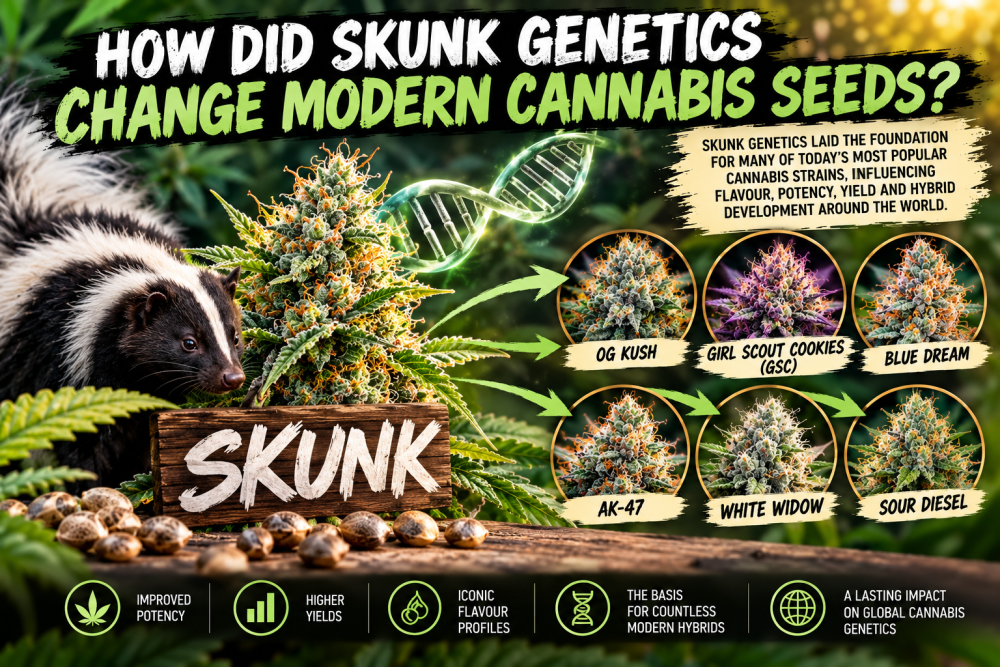
Cannabis Seeds: How Did Skunk Genetics Change Modern Cannabis Seeds?
Skunk genetics changed modern cannabis seeds by helping establish the idea of a stable, predictable hybrid that could be reproduced and then used repeatedly as breeding material. Skunk #1, developed in California during the 1970s and later introduced into the Dutch cannabis seed industry, became a foundation for generations of cannabis strains. Its influence can still be found throughout modern cannabis seeds today.
For anyone browsing cannabis seeds at Discount Cannabis Seeds, the word Skunk might look like simply another strain name or cannabis seed family.
Historically, it means much more than that.
Skunk #1 helped change how breeders thought about cannabis seeds, hybrids and genetic stability. It travelled from California into the emerging Dutch cannabis seed industry, became breeding material for other seed companies and ultimately contributed genetics to an enormous number of later cannabis strains.
Some modern cannabis seeds still carry Skunk directly in their names.
Others don't mention Skunk anywhere on the packet but can still have Skunk-related ancestry several generations back.
That's what makes Skunk genetics so important to the history of modern cannabis seeds.
Where Did Skunk #1 Cannabis Seeds Come From?
The story begins in California during the 1970s.
Skunk #1 is strongly associated with Sacred Seeds and breeder Sam the Skunkman, also known as David Watson.
Historical accounts describe Skunk #1 as a three-way hybrid involving Afghani, Colombian Gold and Acapulco Gold genetic material. SeedFinder records the lineage as (Afghan × Colombian Gold) × Acapulco Gold, while Dutch Passion similarly describes its Skunk #1 as combining Afghan, Acapulco Gold and Colombian Gold ancestry. SeedFinder.eu
This combination was significant.
Rather than simply preserving one geographical cannabis population, breeders were deliberately bringing together genetics from very different backgrounds.
That approach became central to the development of modern cannabis seeds.
Was Skunk #1 the First Cannabis Hybrid?
Cannabis populations had been crossing long before Skunk #1 existed, so describing it as literally the first cannabis hybrid would be misleading.
Its historical importance lies more in the development and stabilisation of the hybrid.
Sensi Seeds describes Skunk #1 as one of the world's most influential cannabis hybrids and notes that Sacred Seeds worked to create cannabis seeds that would reproduce the desired characteristics more consistently. Sensi Seeds
That's an important distinction.
Creating a cross can be relatively straightforward conceptually.
Developing a cannabis seed line that behaves with greater consistency over subsequent generations is much more significant from a breeding perspective.
Skunk #1 demonstrated what carefully selected and stabilised hybrid cannabis seeds could become.
Why Was Genetic Stability So Important?
Imagine buying cannabis seeds where every seed produces something dramatically different from the next.
That variation can be interesting, but it makes a commercial cannabis seed variety difficult to define.
A breeder selling a named variety generally wants some degree of consistency in the characteristics associated with that genetic line.
Historical accounts of Skunk #1 repeatedly emphasise its relative uniformity.
Dutch Passion describes Skunk #1 as a stabilised, homogeneous variety that had been inbred from the late 1970s, while historical material reproduced by SeedFinder describes multiple generations of selection being used in its development. Dutch Passion
This helped make Skunk #1 particularly valuable as breeding material.
- It wasn't simply famous.
- It was useful.
- And useful genetics produce descendants.
How Long Did It Take to Develop Skunk #1?
It wasn't created from one cross and immediately released as a finished cannabis seed variety.
The historical account cited by SeedFinder describes an extended selection programme across multiple growing seasons.
Plants were evaluated and selected repeatedly, with breeders looking for combinations of desirable characteristics and greater uniformity. SeedFinder.eu
That helps explain why Skunk #1 became such an influential parent.
The cannabis seed industry wasn't simply inheriting an interesting cross.
It was gaining access to genetics that had already undergone substantial selection.
When Did Skunk Cannabis Seeds Reach Europe?
This was the next major turning point.
Sam the Skunkman moved to the Netherlands during the mid-1980s and brought important California genetics with him.
Sensi Seeds places his arrival in Amsterdam in 1985 and describes how his work subsequently influenced Dutch cannabis breeding.
Dutch Passion similarly describes Skunk #1 and Haze as important early genetics that entered the emerging Dutch seed industry through connections involving Sam the Skunkman, Nevil Schoenmakers and the Super Sativa Seed Club.
This is where Skunk's influence expanded dramatically.
California breeding genetics were now meeting the rapidly developing European cannabis seed industry.
Why Was Amsterdam So Important?
During the 1980s, the Netherlands was becoming a major centre for commercial cannabis seed breeding.
Early seed companies and breeders exchanged genetics, experimented with imported material and began creating catalogues that could reach customers internationally.
Skunk #1 arrived at exactly the right moment.
Sensi Seeds records that Sam supplied Skunk #1 cannabis seeds to breeders in Amsterdam and that Nevil Schoenmakers subsequently listed Skunk #1 through The Seed Bank of Holland in its 1987 catalogue.
That helped take Skunk genetics beyond a relatively small breeding community.
They became part of an international cannabis seed market.
Did Skunk #1 Help Build the Dutch Cannabis Seed Industry?
It certainly became one of its important genetic foundations.
Dutch breeders suddenly had access to a relatively stabilised hybrid that could be incorporated into further breeding projects.
- Skunk #1 was crossed.
- Its descendants were crossed.
- Some of those descendants became famous cannabis strains themselves.
- Those strains subsequently became parents.
- The effect multiplied.
Dutch Passion describes Skunk #1 as one of three fundamental genetic groups—alongside Haze and Afghan genetics—that profoundly influenced subsequent cannabis breeding.
This is why the history of Skunk cannabis seeds can't really be separated from the history of modern European cannabis seeds.
Why Did So Many Breeders Use Skunk Genetics?
Because influential genetics tend to attract more breeding.
Once breeders recognise useful genetic material, they don't simply preserve it as one finished strain.
They experiment with it.
Skunk #1 was incorporated into crosses with other important cannabis genetics.
Those hybrids could combine Skunk ancestry with completely different genetic families.
A simplified family tree might look like:
Skunk #1
↓
Skunk #1 × another genetic line
↓
New hybrid
↓
New hybrid × another strain
↓
Another generation of cannabis seeds
Repeat that process for decades across numerous breeders and the original Skunk ancestry can spread extraordinarily far.
This is why customers browsing Discount Cannabis Seeds shouldn't assume that only cannabis seeds with Skunk in their product name have any connection to Skunk genetics.
The ancestry may be hidden several generations back.
Did Skunk Genetics Help Create Other Famous Cannabis Strains?
Yes, and this is arguably where Skunk #1's greatest influence lies.
Its genetics were incorporated into numerous breeding programmes and intersected with other important families.
Some descendants retained the Skunk name.
Others didn't.
This created an enormous family tree.
Sensi Seeds says Skunk #1 became so successful that it was crossed extensively and may be among the cannabis strains with the largest number of descendants carrying its name.
But direct Skunk names are only part of the story.
Indirect descendants make its genetic influence much larger.
What Is Super Skunk?
Super Skunk is a perfect example of what happened next.
Instead of treating Skunk #1 as the final destination, breeders combined Skunk genetics with other cannabis genetics to produce new lines.
Those new cannabis seeds could then establish reputations of their own.
This created branches within the Skunk family.
Rather than there being one "Skunk", there could now be generations of Skunk-related cannabis seeds.
Over time, those branches became increasingly distant from the original.
What About Shiva Skunk?
Shiva Skunk represents another famous branch of the wider Skunk family and illustrates what happened when influential cannabis families were combined.
This is a pattern that appears repeatedly throughout cannabis seed history.
- A major parent is crossed with another major genetic family.
- The resulting strain becomes successful.
- That strain is then used as a parent.
- The family tree expands again.
Eventually, customers see hundreds of apparently separate cannabis seed names even though their ancestry overlaps.
How Did Skunk Genetics Influence Haze Cannabis Seeds?
This is where the history becomes particularly interesting.
Skunk and Haze were both enormously influential early genetic families.
Breeders didn't keep them completely separate.
They combined them.
Dutch Passion notes that its Super Haze—formerly described as Haze × Skunk #1—won first prize at the High Times Cannabis Cup in Amsterdam in 1992.
That represents something fundamental about modern cannabis seeds:
The major genetic families started merging.
Instead of:
Skunk
versus
Haze
breeders could create:
Skunk × Haze
Those offspring could subsequently be crossed with Northern Lights, Afghani genetics or other families.
Modern cannabis breeding became a network.
Did Skunk Genetics Influence Jack Herer?
Skunk genetics are also part of the wider genetic history associated with several celebrated hybrids from the following era.
This is where tracing cannabis seeds becomes fascinating.
A modern strain might descend from another famous strain that itself contained Skunk ancestry.
The word Skunk disappears from the product name.
The genetic connection remains.
This is why the breeder and stated lineage are so important when comparing cannabis seeds at Discount Cannabis Seeds.
The front of a cannabis seed packet rarely tells the entire family story.
What About Cheese Cannabis Seeds?
Cheese is one of the most interesting examples for UK cannabis history.
Cheese became associated with a distinctive selection originating from Skunk #1 genetics.
That meant a branch of Skunk genetics effectively developed a new identity.
Skunk #1
↓
distinctive Skunk selection
↓
Cheese
↓
Cheese-related hybrids
Once Cheese genetics were subsequently crossed into other cannabis strains, another large family developed.
A customer looking at modern Cheese-related cannabis seeds may therefore be several generations removed from the original Skunk #1 while still exploring part of the wider Skunk family.
For a UK cannabis seed bank such as Discount Cannabis Seeds, this historical connection is particularly interesting because Cheese became one of the most recognisable cannabis names in Britain.
Why Does "Skunk" Mean Something Different in the UK?
This creates a lot of confusion.
In Britain, skunk eventually became a general slang term for potent cannabis.
That doesn't mean every product described colloquially as "skunk" is genetically descended from Skunk #1.
Sensi Seeds specifically makes this distinction, noting that although the word became widely used in the UK for potent cannabis, not all such cannabis is genetically related to the original Skunk #1.
For cannabis seed collectors, this distinction matters.
Skunk as slang and Skunk as a genetic family aren't necessarily the same thing.
When researching cannabis seeds at Discount Cannabis Seeds, look for the breeder's stated genetics rather than assuming a genetic relationship from informal terminology.
Did Skunk #1 Change How Cannabis Seeds Were Named?
Indirectly, yes.
The success of Skunk helped turn a genetic family name into a powerful commercial identity.
Once Skunk became recognised internationally, new crosses could benefit from retaining the famous name.
This contributed to cannabis seed names such as:
Super Skunk
Skunk hybrids
Skunk crosses
and numerous breeder-specific interpretations.
The same pattern would later become common with other successful genetic families.
A famous cannabis strain doesn't just produce genetic descendants.
It can produce a naming family.
Does Every Cannabis Seed With "Skunk" in the Name Contain Original Skunk #1?
Not necessarily.
This is exactly why cannabis seed names should never be treated as genetic certificates.
Over decades, names can be reused.
Breeders can produce their own interpretations.
Different selections can develop.
And "Skunk" became such a widely recognised cannabis term that the word itself acquired commercial value.
If you're comparing Skunk cannabis seeds at Discount Cannabis Seeds, check:
- The breeder.
- The stated parents.
- The product description.
- Whether the breeder identifies Skunk #1 ancestry.
- Whether it's an original line, descendant or newer hybrid.
- That tells you much more than the word Skunk alone.
Did Skunk Genetics Influence Feminised Cannabis Seeds?
Yes, although these are two separate parts of cannabis seed history.
Skunk describes a genetic family.
Feminised describes a type of cannabis seed.
When feminised cannabis seeds became commercially established during the late 1990s, older genetic families could subsequently be offered in feminised formats.
Dutch Passion notes that it became the first company to offer feminised Skunk cannabis seeds during the late 1990s. Dutch Passion
This allowed decades-old Skunk genetics to enter a newer era of cannabis seed technology.
Today, collectors can encounter Skunk-related genetics in both traditional and newer seed formats.
Did Skunk Genetics Become Autoflower Cannabis Seeds Too?
Yes.
This happened later.
As autoflower cannabis seeds became increasingly established, breeders began combining the autoflowering characteristic with famous existing cannabis genetic families.
Skunk genetics were among them.
Sensi Seeds, for example, says it introduced a feminised version of its Skunk #1 in 2007 and an autoflowering version in 2013. Sensi Seeds
This shows how one genetic family can survive several generations of cannabis seed innovation.
- First there were regular Skunk cannabis seeds.
- Then feminised Skunk cannabis seeds.
- Then autoflowering interpretations.
The underlying historical name survived while the commercial seed formats evolved.
Why Is This Important When Browsing Autoflower Cannabis Seeds?
Because an autoflower isn't necessarily a completely new genetic family.
A modern autoflower cannabis seed can combine the autoflowering characteristic with ancestry from much older photoperiod genetics.
This is something worth remembering when browsing autoflower cannabis seeds at Discount Cannabis Seeds.
An Auto version of an established genetic family may have a modern seed format while drawing part of its ancestry from cannabis genetics developed decades earlier.
The modern cannabis seed market constantly combines old and new.
How Did Skunk Genetics Change What Breeders Expected From Cannabis Seeds?
One of Skunk #1's most important contributions was demonstrating the value of a relatively stable hybrid.
Dutch Passion describes earlier imported cannabis seeds as often producing substantial variation, whereas Skunk #1 represented a much more stabilised commercial variety. Dutch Passion
That changed expectations.
A named cannabis strain could represent more than an interesting cross.
Breeders could work towards greater uniformity.
That became increasingly important as the commercial cannabis seed industry expanded.
Customers weren't simply purchasing unidentified imported cannabis seeds anymore.
They were purchasing named genetics from specific breeders.
That's the foundation of the cannabis seed market we recognise today.
Did Skunk Help Make the Breeder More Important?
Yes.
Once cannabis seeds became associated with deliberately developed genetic lines, breeder identity became increasingly meaningful.
- Who created the strain?
- Which version is it?
- Which parent genetics were used?
- How was the line preserved?
Those questions matter because different breeders can work with related genetics differently.
This remains important at Discount Cannabis Seeds, where cannabis seeds from numerous breeders are available in one place.
Two cannabis seeds with similar names don't automatically represent identical genetics.
Knowing the breeder provides additional provenance.
Did Skunk Genetics Influence the Idea of Original Breeder Cannabis Seeds?
They certainly demonstrate why provenance matters.
Once famous genetics spread internationally, different versions inevitably appeared.
- Some came from original material.
- Others were descendants.
- Some were later recreations.
- Some retained the famous name despite genetic differences.
That's why collectors interested in classic cannabis seeds often pay attention to original breeder cannabis seeds and documented lineage.
At Discount Cannabis Seeds, customers can compare original breeder products alongside DCS cannabis seeds and genetics from numerous international seed companies.
Understanding the history behind a name makes those comparisons much more meaningful.
Why Are There So Many Skunk Cannabis Seeds Today?
Because successful genetics rarely remain one product.
- They become breeding material.
- Imagine one successful cannabis strain being crossed by ten breeders.
- Those ten crosses create ten new strains.
- Several become popular.
- Each of those is crossed again.
Within a few generations, the original genetic family can spread across hundreds of cannabis seed products.
Do that over more than four decades and the family tree becomes enormous.
Dutch Passion describes Skunk #1 as a cornerstone used in countless crosses and hybridisations over the years.
That's the real reason Skunk genetics became so influential.
Not because everybody continued buying only original Skunk #1 cannabis seeds.
Because breeders kept building on them.
Did Skunk Genetics Make Modern Cannabis Less Diverse?
Not necessarily.
This needs nuance.
Repeated use of highly successful parents can concentrate certain ancestry throughout commercial breeding populations.
But crossing Skunk with other genetic families also created new combinations.
- Skunk genetics mixed with Haze.
- Afghani genetics.
- Other European breeding lines.
- Later American genetics.
- And many more.
So Skunk simultaneously became extremely widespread while contributing to an expanding number of hybrid combinations.
Modern cannabis seeds can therefore be highly interconnected while still showing substantial genetic variation.
Can Modern Cannabis Seeds Have Skunk Ancestry Without Anyone Realising?
Absolutely.
This is one of the most interesting parts of cannabis genealogy.
Imagine:
Skunk #1
↓
Hybrid A
↓
Hybrid B
↓
Hybrid C
↓
Modern Strain
If the modern strain receives a completely new name, nothing on the front of the cannabis seed packet necessarily tells you that Skunk #1 appears four generations back.
You only discover it by tracing the reported lineage.
That's why our genetics guides at Discount Cannabis Seeds focus so heavily on ancestry rather than names alone.
Is Skunk #1 Still Important if Newer Genetics Are More Fashionable?
Yes.
Fashion and historical influence are different things.
A newer strain may dominate cannabis seed searches today.
That doesn't erase the genetics that helped produce the generations before it.
Skunk #1's importance lies partly in its position near the foundation of the modern commercial cannabis seed family tree.
Modern genetics can become fashionable and disappear again.
A foundation strain remains important because its descendants continue carrying parts of its ancestry forward.
Is Skunk #1 One of the Most Important Cannabis Strains Ever Created?
It has an extremely strong claim.
Sensi Seeds calls it one of the most influential hybrids in cannabis history, while Dutch Passion describes Skunk alongside Haze and Afghan genetics as one of the fundamental building blocks behind modern cannabis strains. Sensi Seeds
- Its importance comes from several things happening together:
- It combined geographically different cannabis genetics.
- It underwent extensive selection and stabilisation.
- It moved from California into the Dutch cannabis seed industry.
- It became internationally distributed as cannabis seeds.
- Breeders used it repeatedly as a parent.
- Its descendants became parents themselves.
- And its name became internationally recognised.
- Few individual cannabis strains have influenced both genetics and cannabis culture to the same extent.
How Did Skunk Genetics Influence Modern DCS Cannabis Seeds?
The wider significance for Discount Cannabis Seeds isn't that every DCS cannabis seed is descended from Skunk #1—they aren't.
It's that Skunk helped establish the breeding model that eventually produced the diverse cannabis seed industry we have today.
Modern DCS cannabis seeds sit within an industry built around:
- Named genetic lines.
- Documented parent crosses.
- Feminised cannabis seeds.
- Autoflower cannabis seeds.
- Hybrid cannabis seeds.
- Breeder provenance.
- Genetic families.
And continual crossing between older and newer genetics.
Those concepts developed over decades, and Skunk #1 occupies an important place near the beginning of that modern breeding story.
Why Look at Genetics When Buying Cannabis Seeds?
Because a cannabis seed name only tells part of the story.
When browsing cannabis seeds at Discount Cannabis Seeds, looking at the genetic lineage can reveal whether a modern strain contains older genetic families.
A brand-new name could contain ancestry connected with Skunk, Haze, Kush, Afghani genetics, Cookies or another influential line.
The breeder may also have developed its own selection or interpretation.
Looking at breeder + strain name + stated lineage + cannabis seed type gives you much more context than looking at the strain name alone.
Can You Find Classic and Modern Cannabis Seeds at Discount Cannabis Seeds?
Yes.
Discount Cannabis Seeds brings together cannabis seeds from established international breeders alongside newer genetic companies and the exclusive DCS cannabis seed range.
That makes it possible to explore different eras of cannabis genetics in one cannabis seed catalogue.
Some cannabis seeds are associated with classic genetic families.
Others represent modern hybrids.
Some combine old-school ancestry with newer genetics.
And others demonstrate how established strain families have evolved into feminised cannabis seeds or autoflower cannabis seeds.
For collectors interested in genetics, that's where a multi-breeder cannabis seed bank becomes particularly useful: you can compare different branches of cannabis history rather than seeing only one breeder's catalogue.
How Did Skunk Genetics Change Modern Cannabis Seeds?
Skunk genetics helped change modern cannabis seeds in three major ways.
First, Skunk #1 demonstrated the commercial value of a relatively stable hybrid cannabis seed line.
Rather than simply making one interesting cross, breeders could select and stabilise genetics across generations.
Second, Skunk #1 became one of the foundation parents of modern cannabis breeding.
After reaching the Netherlands during the 1980s, its genetics spread through the emerging Dutch cannabis seed industry and were incorporated into numerous new hybrids. Sensi Seeds
Third, its descendants became breeding parents themselves.
- That's where the influence multiplied.
- Skunk stopped being simply one strain.
- It became an enormous genetic family.
Explore Cannabis Seeds at Discount Cannabis Seeds
The history of Skunk #1 shows why understanding cannabis seeds means looking beyond modern strain names.
A cannabis seed released today can carry genetic history stretching back decades.
At Discount Cannabis Seeds, collectors can explore cannabis seeds from established breeders, feminised cannabis seeds, autoflower cannabis seeds, classic genetic families, modern hybrids and exclusive DCS cannabis seeds.
When comparing cannabis seeds, look at the breeder and stated lineage as well as the name.
You might start with a completely modern cannabis strain and discover that somewhere in its family tree sits one of the most influential hybrids ever developed.
More than four decades after the original Skunk #1 cannabis seeds emerged, the name is still recognised around the world.
But Skunk's greatest legacy isn't the name.
It's the thousands of modern cannabis seeds and genetic families that were influenced by what came afterwards.