




Cannabis Seeds: Indoor Breeding vs Outdoor Breeding.
How Cannabis Seeds Are Developed in Different Environments.
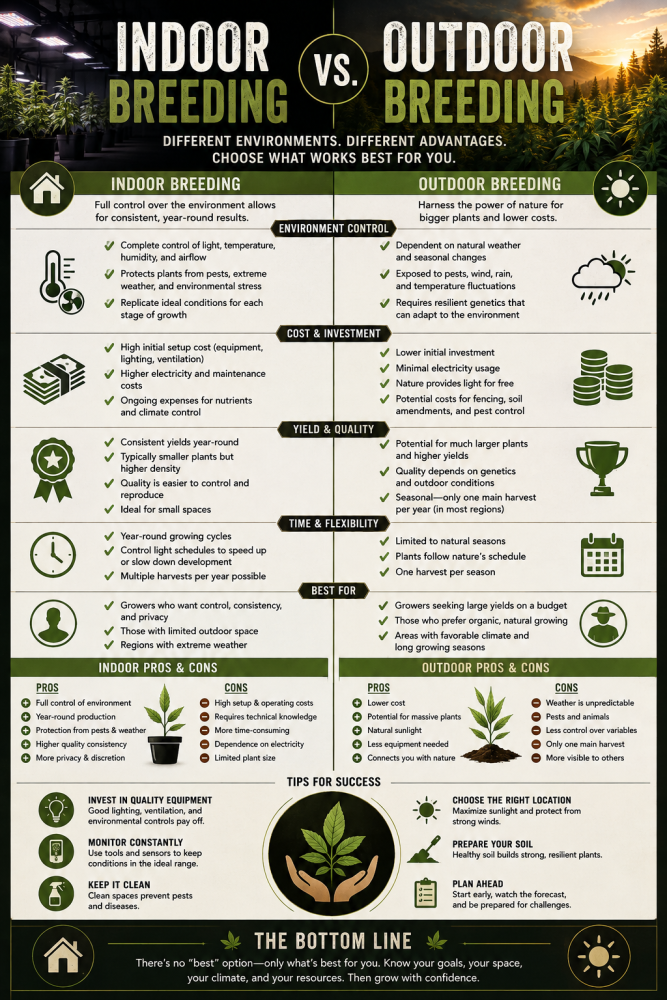
Indoor breeding and outdoor breeding are two important methods used to develop cannabis seeds. Indoor breeding gives breeders greater control over environmental conditions, while outdoor breeding allows cannabis seeds to develop under natural sunlight and seasonal conditions. Both approaches have contributed to some of the world's most respected cannabis genetics, and each offers unique advantages depending on a breeder's goals.
Modern cannabis seeds are the result of years of careful breeding, but few growers stop to consider where that breeding actually takes place. Some breeders work almost entirely indoors using highly controlled environments, while others rely on outdoor fields or greenhouses to develop and refine their cannabis seeds.
Neither method is automatically better than the other. Instead, indoor and outdoor breeding complement one another, helping breeders create cannabis seeds suited to a wide variety of growing conditions.
This guide explores the differences between indoor and outdoor breeding, explains how each approach influences cannabis seeds, and highlights why both remain essential to modern cannabis genetics.
Indoor breeding involves producing cannabis seeds inside carefully controlled growing environments.
These facilities may include:
Indoor grow rooms.
Controlled breeding chambers.
Research facilities.
Environmental testing rooms.
Climate-controlled cultivation spaces.
By managing every aspect of the environment, breeders can carefully evaluate cannabis seeds under highly consistent conditions.
Outdoor breeding uses natural environmental conditions to develop cannabis seeds.
Breeders may work in:
Open fields.
Dedicated breeding farms.
Seasonal cultivation sites.
Agricultural breeding plots.
Outdoor research gardens.
Natural sunlight and changing weather conditions play an important role throughout the breeding process.
Why Do Breeders Use Indoor Breeding?
Indoor breeding offers exceptional environmental control.
Breeders can regulate:
Lighting.
Temperature.
Humidity.
Air circulation.
Photoperiod.
Pollination timing.
This allows cannabis seeds to be developed under repeatable conditions, making it easier to compare different generations.
Advantages of Indoor Breeding.
Many leading breeders rely on indoor breeding because it offers:
Greater environmental consistency.
Controlled pollination.
Precise breeding programmes.
Multiple breeding cycles each year.
Easier phenotype evaluation.
Reduced environmental variation.
These advantages make indoor breeding particularly useful when refining modern cannabis seeds.
Why Outdoor Breeding Still Matters.
Despite advances in indoor technology, outdoor breeding continues to play an important role.
Natural environments allow breeders to observe how cannabis seeds perform under real-world conditions.
Outdoor breeding helps evaluate:
Seasonal adaptability.
Natural plant development.
Environmental resilience.
Long-term stability.
Performance across varying weather conditions.
Many legendary cannabis seeds were originally developed outdoors.
Advantages of Outdoor Breeding.
Outdoor breeding offers several unique benefits.
These include:
Natural sunlight.
Large breeding populations.
Full seasonal development.
Broad environmental testing.
Natural selection opportunities.
Efficient large-scale breeding.
These conditions help breeders better understand how cannabis seeds respond outside controlled environments.
Indoor vs Outdoor: Environmental Control.
One of the biggest differences between breeding methods is environmental control.
Indoor breeding allows breeders to control:
Light intensity.
Day length.
Temperature.
Humidity.
Airflow.
Pollination.
Outdoor breeding depends on:
Natural sunlight.
Seasonal weather.
Rainfall.
Wind.
Local climate.
Natural growing conditions.
Both approaches provide valuable information when developing cannabis seeds.
Which Produces Better Cannabis Seeds?
Neither indoor nor outdoor breeding is inherently superior.
The quality of cannabis seeds depends far more on:
Breeding expertise.
Parent selection.
Genetic stability.
Multi-generation testing.
Careful evaluation.
Many of the world's most famous cannabis seeds have been developed using a combination of indoor and outdoor breeding techniques.
Modern Breeders Often Use Both.
Today's leading cannabis seed companies rarely rely on only one breeding method.
Instead, they may:
Begin projects indoors.
Test genetics outdoors.
Compare multiple environments.
Refine breeding over several generations.
Confirm consistency under different conditions.
This combined approach produces cannabis seeds that perform reliably across a wider range of growing environments.
How Breeding Environment Influences Cannabis Seeds.
Breeding location can affect how breeders evaluate genetics, but it does not define the quality of the cannabis seeds themselves.
Indoor breeding is often ideal for:
Controlled experiments.
Hybrid development.
Parent selection.
Genetic stabilisation.
Outdoor breeding is often valuable for:
Environmental testing.
Adaptability assessments.
Seasonal evaluation.
Large breeding projects.
Together, these methods help improve modern cannabis seeds.
Indoor vs Outdoor Breeding Comparison.
Feature. Indoor Breeding. Outdoor Breeding.
Growing environment. Fully controlled. Natural conditions.
Lighting. Artificial. Sunlight.
Climate. Controlled. Seasonal.
Pollination. Highly controlled. Carefully managed outdoors.
Breeding cycles. Multiple per year. Seasonal.
Environmental testing. Limited. Extensive.
Consistency. Very high. Variable natural conditions.
Which Breeding Method Has Produced Famous Cannabis Seeds?
Both.
Legendary cannabis seeds such as:
Northern Lights.
Skunk #1.
White Widow.
Jack Herer.
Blueberry.
OG Kush.
owe their success to decades of careful breeding, with many projects involving both indoor refinement and outdoor evaluation.
Modern cannabis seeds continue to benefit from this balanced approach.
Why Understanding Breeding Methods Helps You Choose Cannabis Seeds.
Learning how cannabis seeds are developed provides valuable insight into the work carried out by professional breeders.
Instead of focusing only on strain names, growers can better appreciate:
Genetic refinement.
Breeding history.
Parent selection.
Stabilisation.
Long-term development.
Breeder expertise.
This knowledge makes comparing cannabis seeds much more meaningful.
Why Learn About Cannabis Seed Breeding at Discount Cannabis Seeds?
Every cannabis seed begins with years of careful breeding, and understanding those breeding methods helps growers appreciate the genetics they're buying. Discount Cannabis Seeds offers far more than a catalogue of strains—it provides the information needed to understand how modern cannabis seeds are developed.
Explore Genetics From Experienced Breeders.
Browse cannabis seeds from internationally respected breeders who use decades of breeding knowledge to develop stable, dependable genetics for growers around the world.
Compare More Than Just Strain Names.
Each cannabis seed listing includes detailed information about:
Genetic lineage.
Parent strains.
Seed type.
Flowering period.
Plant height.
Growing suitability.
Breeder background.
This allows growers to compare cannabis seeds based on breeding quality rather than marketing alone.
Discover the Science Behind Cannabis Seeds.
Discount Cannabis Seeds features educational resources covering breeding techniques, genetic terminology, breeder profiles, cannabis seed history, and cultivation knowledge, helping growers understand the journey from parent plants to finished cannabis seeds.
Make Better Decisions for Future Grows.
Whether you're interested in classic genetics or the latest hybrids, learning how breeders create cannabis seeds can help you choose varieties that match your growing environment and long-term goals.
Frequently Asked Questions.
What is indoor cannabis seed breeding?
Indoor breeding involves developing cannabis seeds inside carefully controlled environments where breeders manage lighting, temperature, humidity, and pollination to evaluate genetics with high consistency.
What is outdoor cannabis seed breeding?
Outdoor breeding produces cannabis seeds under natural growing conditions, allowing breeders to assess genetics in real-world environments throughout the growing season.
Which breeding method produces better cannabis seeds?
Neither method is automatically better. High-quality cannabis seeds depend on breeder expertise, genetic selection, stabilisation, and careful testing rather than whether breeding takes place indoors or outdoors.
Do professional breeders use both methods?
Yes. Many breeders combine indoor and outdoor breeding to refine genetics under controlled conditions before evaluating them in natural environments.
Why should growers understand breeding methods?
Learning how cannabis seeds are developed helps growers better understand breeder quality, genetic stability, and the work involved in producing dependable cannabis seeds.
Indoor and outdoor breeding both play essential roles in the development of modern cannabis seeds. Indoor environments provide breeders with the precision needed to refine genetics and control every stage of the breeding process, while outdoor cultivation allows those same genetics to be evaluated under natural conditions.
Rather than competing approaches, indoor and outdoor breeding complement one another. Together, they enable breeders to create cannabis seeds that combine genetic stability with environmental adaptability, giving growers access to some of the most refined and dependable genetics ever developed.
This article is intended for educational and informational purposes only. Cannabis cultivation laws vary between countries, states, provinces, and local jurisdictions. Before purchasing, possessing, or cultivating cannabis seeds, ensure you understand and comply with all applicable laws where you live. This content does not constitute legal, medical, or cultivation advice.
Molly is a writer specialising in cannabis seeds, breeder history, and cannabis genetics. She researches modern breeding techniques, genetic development, and cultivation science to produce informative articles that help growers understand how today's cannabis seeds are created and refined.