




Cannabis Seeds: When Did Autoflower Cannabis Seeds First Become Popular?
Autoflower cannabis seeds began attracting serious attention in the early 2000s, particularly after the arrival of Lowryder, created by breeder The Joint Doctor. Lowryder reached the commercial market around 2002–2003 and is widely credited with proving that a stable autoflowering cannabis strain could be commercially viable. However, autoflower cannabis seeds didn't become truly mainstream overnight. Their popularity increased throughout the late 2000s and 2010s as breeders improved the genetics and more major cannabis seed companies introduced autoflower collections. Leafly
Today, autoflower cannabis seeds are one of the major categories within the international cannabis seed industry. At Discount Cannabis Seeds, collectors can now browse autoflower cannabis seeds from numerous established breeders alongside exclusive DCS autoflower genetics — a level of choice that would have been almost unimaginable when the first commercial autos appeared.
But where did autoflower genetics actually come from, and why did it take so long for them to become popular?
Were Autoflower Cannabis Seeds Always Available?
No.
For most of the history of commercial cannabis seeds, the varieties sold by seed banks were photoperiod genetics.
The autoflowering trait existed naturally, but turning it into commercially successful cannabis seed varieties proved much more difficult.
The genetic story behind modern autoflower cannabis seeds is strongly associated with Cannabis ruderalis.
Ruderalis developed in regions with very different environmental conditions from many traditional cannabis populations and became particularly interesting to breeders because flowering was less dependent on changing daylight periods.
However, early ruderalis genetics weren't initially considered particularly desirable by many cannabis breeders.
Dutch Passion's history of autoflower genetics recalls considerable scepticism during the 1980s because ruderalis was associated with low potency and characteristics that didn't compare favourably with the leading commercial genetics of the period. Dutch Passion
The autoflowering characteristic was interesting.
Turning it into commercially desirable cannabis seeds was the difficult part.
Were There Autoflowering Cannabis Strains Before Lowryder?
Yes.
This is an important distinction.
Lowryder wasn't the first cannabis plant ever discovered with autoflowering characteristics.
Earlier breeders had experimented with ruderalis and related genetics.
Leafly reports that Ruderalis Indica and Ruderalis Skunk were among the earliest commercial attempts at autoflowering varieties. However, the autoflowering characteristic wasn't fully stabilised and approximately half of the resulting plants reportedly failed to autoflower. Leafly
Consequently, these early experiments didn't transform the cannabis seed market.
Something more reliable was needed.
That brings us to the strain that changed the history of autoflower cannabis seeds.
When Was Lowryder Released?
The key breakthrough came around 2002–2003.
The exact year is sometimes given differently in historical accounts, but The Joint Doctor himself stated in a later interview that the first batch of Lowryder seeds was commercially sold in 2003. Fast Buds
Lowryder had already spent several years in development before reaching the market.
The Joint Doctor initially called the developing genetics Willy's Automatic, and the line eventually became Lowryder. Dutch Passion
This small cannabis strain would have an enormous influence on what came afterwards.
Who Created Lowryder?
Lowryder was developed by The Joint Doctor, also known as Sasha Przytyk.
According to The Joint Doctor's account of the breeding project, unusual autoflowering genetics eventually became the foundation for the strain.
The history commonly involves Mexican Rudy, Northern Lights #2 and William's Wonder genetics, although historical accounts of the exact early lineage aren't completely uniform. Dutch Passion
What mattered most to the emerging cannabis seed industry wasn't simply the name of the parents.
It was the trait The Joint Doctor managed to stabilise.
Lowryder could flower according to maturity rather than relying on the traditional photoperiod response associated with most cannabis genetics.
That was the breakthrough.
Why Was It Called Lowryder?
The name suited the unusual genetics.
Lowryder was exceptionally compact compared with many traditional cannabis strains.
Royal Queen Seeds' history of the variety credits The Joint Doctor with creating the first commercially successful fully autoflowering strain and explains that the Lowryder name reflected its unusually small stature. Royal Queen Seeds
At the time, however, not everybody saw this as the beginning of a revolution.
Quite the opposite.
Were Early Autoflower Cannabis Seeds Popular?
Not immediately.
This is one of the most interesting parts of autoflower history.
Today, autoflower cannabis seeds occupy substantial sections of modern seed catalogues.
In the early 2000s, many experienced cannabis enthusiasts were sceptical.
Early autos developed a reputation for being:
- Small.
- Limited in genetic choice.
- Less potent than established photoperiod genetics.
- Lower yielding than conventional varieties.
Leafly's history of the early autoflower movement describes Lowryder as commercially successful but notes that many experienced consumers and growers remained dismissive of the genetics. Leafly
So 2003 shouldn't really be described as the year autoflower cannabis seeds became universally popular.
It was the year the modern autoflower market started becoming commercially significant.
Why Was Lowryder So Important?
Because it demonstrated that the autoflowering characteristic could be stabilised sufficiently for a commercial cannabis seed product.
That gave other breeders something to build upon.
Before Lowryder, autoflower genetics were largely an unusual breeding experiment.
After Lowryder, breeders could see commercial potential.
This distinction is important when looking through today's autoflower cannabis seeds at Discount Cannabis Seeds.
Modern autoflower catalogues contain numerous genetic families and breeder interpretations, but much of that market can trace its development back to experimentation that accelerated after Lowryder appeared.
Lowryder didn't represent the finished product.
It helped demonstrate what might eventually be possible.
What Happened After Lowryder?
Other breeders started experimenting.
This is when autoflower cannabis genetics began evolving much more quickly.
The Joint Doctor continued developing autoflowering varieties.
Other seed companies started incorporating autoflower genetics into their own breeding programmes.
Dutch and Spanish breeders became increasingly involved.
Existing photoperiod genetic families began being combined with autoflowering lines.
As the years passed, breeders worked to address the characteristics that had made early autos controversial.
Leafly describes this as a gradual process: more seed banks began experimenting with the genetics and subsequent generations improved considerably. Leafly
The cannabis seed market was beginning to change.
When Did Dutch Passion Start Developing Autoflower Cannabis Seeds?
Dutch Passion was one of the established cannabis seed companies that became involved during the early development of modern autos.
The company says it worked closely with The Joint Doctor in the early 2000s, recognising the potential of the emerging genetics despite their limitations. Dutch Passion
That's significant because Dutch Passion had already been operating since 1987 and had previously played an important role in the commercial development of feminised cannabis seeds.
An established breeder taking autoflower genetics seriously helped move the category beyond its experimental origins.
Dutch Passion subsequently developed its own autoflowering cannabis seed varieties.
Today, collectors can find Dutch Passion cannabis seeds through Discount Cannabis Seeds, demonstrating how a breeder associated with the early development of modern autoflowers remains part of today's cannabis seed market.
When Did Feminised Autoflower Cannabis Seeds Appear?
This was another major step.
Early autoflower genetics and modern feminised autoflower cannabis seeds shouldn't automatically be treated as the same stage of development.
Once breeders were able to combine reliable autoflowering characteristics with feminised seed production, the commercial appeal of the category increased substantially.
Dutch Passion describes its first generation of feminised autoflower cannabis seeds as an important stage in the evolution of the category. Dutch Passion
That helped create the type of product most people now associate with the words autoflower cannabis seeds.
Instead of autoflowering being an unusual trait attached to a tiny experimental niche, it was becoming a recognisable commercial seed category.
Did Autoflower Cannabis Seeds Become Popular in the 2000s or 2010s?
The best answer is:
- Both — but in different ways.
- The early 2000s were the breakthrough period.
- Lowryder demonstrated the commercial possibilities.
- The mid-to-late 2000s were an important development period as more breeders experimented with autoflower genetics.
The 2010s were when autoflower cannabis seeds became increasingly mainstream and the choice available to collectors expanded dramatically.
So if somebody asks:
When were autoflower cannabis seeds invented?
The history stretches back through much earlier ruderalis experiments.
When did the modern commercial autoflower era begin?
Around 2002–2003 with Lowryder.
When did autoflower cannabis seeds become mainstream?
Broadly, during the late 2000s and especially throughout the 2010s, as genetic quality and breeder participation increased.
That distinction gives a much more accurate picture than choosing one single year.
Why Did Autoflower Cannabis Seeds Become More Popular?
The biggest factor was simple:
- The genetics improved.
- Early autoflowers had an image problem.
- Many cannabis enthusiasts associated "autoflower" with the characteristics of the earliest commercial generations.
- But breeders didn't stop with those early varieties.
They continued crossing and selecting autoflower genetics while introducing characteristics associated with established photoperiod genetic families.
Over successive generations, the gap between the two categories narrowed considerably.
Dutch Passion describes early autoflowers as offering medium potency and yields at best, while later breeding substantially improved their performance. Dutch Passion
As the genetics improved, attitudes changed.
More Breeders Started Creating Autoflower Versions of Famous Strains.
This was another turning point.
Early autoflower catalogues were limited.
Eventually, collectors began seeing familiar cannabis strain names appearing in autoflower form.
Instead of choosing between a handful of obscure auto varieties, customers could explore autoflower interpretations connected with recognised genetic families.
This helped make the category easier to understand.
The word Auto began appearing before or after familiar strain names throughout cannabis seed catalogues.
Today, that naming convention is completely normal.
Browse autoflower cannabis seeds through Discount Cannabis Seeds and you'll find a dramatically broader selection than existed during the Lowryder era.
That expansion itself tells the story of how successful the category became.
Did Every Autoflower Version Come From the Same Genetics?
No.
This connects with an important point from our previous Discount Cannabis Seeds guide about different strains sharing the same name.
Two breeders can both offer an autoflower version associated with a famous strain name without those products necessarily being genetically identical.
Each breeder may have developed its autoflower line differently.
The autoflowering donor genetics can differ.
Selections can differ.
Parent stock can differ.
Breeding generations can differ.
So when comparing autoflower cannabis seeds at Discount Cannabis Seeds, look beyond the strain name.
Check the breeder and the stated genetics too.
When Did Autoflower Specialists Appear?
As the market expanded, some breeders began concentrating heavily on autoflower genetics rather than treating autos as a small addition to a predominantly photoperiod catalogue.
This was an important stage in the maturation of the category.
Instead of simply creating an "Auto" version of an established name, breeders began developing increasingly sophisticated autoflower genetic libraries.
Companies such as Fast Buds became strongly associated with the modern autoflower market.
That would have been difficult to imagine when Lowryder first appeared.
Autoflowers had moved from novelty genetics to an entire specialist segment of the cannabis seed industry.
Discount Cannabis Seeds now stocks cannabis seeds from established breeders as well as breeders associated strongly with modern autoflower genetics, allowing collectors to compare how different companies have approached the category.
How Different Are Modern Autoflower Cannabis Seeds From Early Autos?
Very different in terms of the commercial selection available.
The first autoflower market revolved around a relatively small number of genetics.
Modern seed catalogues contain autos associated with:
- Classic genetic families.
- Modern American genetics.
- Fruit-inspired strains.
- Dessert genetics.
- Old-school cannabis names.
- New proprietary crosses.
- CBD-focused varieties.
- And numerous breeder-exclusive lines.
This diversification is one of the clearest indications of how far autoflower cannabis seeds have travelled from their early-2000s origins.
They stopped being one unusual type of cannabis seed.
They became a huge genetic category of their own.
Did Autoflowers Replace Feminised Cannabis Seeds?
No.
This is a common misunderstanding because the categories can overlap.
"Feminised" describes one characteristic of the seed.
"Autoflower" describes another.
Modern autoflower cannabis seeds are commonly feminised.
Meanwhile, what people often call "feminised cannabis seeds" in seed-bank navigation usually refers to feminised photoperiod varieties.
Both categories remain important within the modern cannabis seed market.
That's why Discount Cannabis Seeds separates seed types and breeder collections, making it easier to explore autoflower cannabis seeds alongside feminised photoperiod genetics rather than treating one as a replacement for the other.
What Happened to Regular Autoflower Cannabis Seeds?
They exist, but the mainstream commercial market became dominated by feminised autoflower seeds.
That's another way the category changed from its experimental beginnings.
Modern customers often encounter "autoflower" and automatically expect feminised seeds unless the product description specifically states otherwise.
Again, the product information matters.
Don't rely solely on the strain name.
What Role Did Cannabis Ruderalis Play?
Cannabis ruderalis sits at the beginning of the autoflower story.
Its unusual flowering behaviour gave breeders the genetic characteristic they wanted to exploit.
But the modern autoflower market shouldn't simply be thought of as a catalogue of ruderalis.
Breeders spent years combining the autoflowering characteristic with other cannabis genetics.
That's why modern autoflower strains can have complex family trees.
The ruderalis connection explains where the autoflowering characteristic originated historically.
It doesn't mean every modern autoflower is otherwise genetically identical.
Are All Modern Autoflowers Descended From Lowryder?
It's safer not to claim that every modern autoflower cannabis seed is a direct Lowryder descendant.
Lowryder had enormous influence and helped launch the modern commercial autoflower movement, but autoflowering genetics have multiple historical threads and breeders have subsequently worked with different material.
What we can say with much more confidence is:
Lowryder was the strain that transformed autoflowering cannabis from an obscure breeding concept into a commercially significant category.
That's why it occupies such an important place in cannabis seed history.
When Did Autoflower Cannabis Seeds Arrive in the UK?
Pinning this to one exact year is difficult.
Cannabis seed genetics were already moving internationally during the early 2000s, and Lowryder became commercially available internationally during that period.
As European seed companies expanded their autoflower catalogues, the category became increasingly visible to UK cannabis seed collectors as well.
By the 2010s, autoflower cannabis seeds were no longer an unusual specialist product within European seed catalogues.
Today they're one of the major seed categories available from UK cannabis seed banks such as Discount Cannabis Seeds.
That's an extraordinary change in roughly two decades.
Why Do Autoflower Cannabis Seeds Have So Many Different Names Today?
Success created diversity.
Once breeders recognised that autoflower genetics had a substantial market, they began combining the autoflowering characteristic with many different genetic families.
That produced hundreds of new names.
Some clearly identify themselves using "Auto".
Others use "Automatic".
And some modern autoflower strains use branding that doesn't immediately reveal their history without reading the product information.
This is why the breeder, seed type and stated lineage are increasingly useful when comparing modern cannabis seeds.
Are Classic Autoflower Cannabis Seeds Still Important?
Historically, absolutely.
Even if modern collectors are more interested in newer autoflower genetics, early varieties such as Lowryder remain important because they help explain how the entire category developed.
It's similar to looking at famous cannabis genetics from the 1980s and 1990s.
The newest releases may be more fashionable, but understanding the older genetics explains how the modern market arrived where it is today.
That's why the history behind cannabis seeds is becoming such an interesting part of the Discount Cannabis Seeds blog.
We're not only looking at what's available now.
We're tracing how different seed categories, breeders and genetic families developed.
How Big Is the Autoflower Cannabis Seed Market Today?
Consider the difference.
Around 2003, Lowryder was unusual enough to generate scepticism simply because a stable commercial autoflower was still a novelty.
Today, major cannabis seed companies maintain extensive autoflower collections.
Specialist autoflower breeders exist.
Classic strain names have autoflower interpretations.
Entirely new genetics are developed specifically for the category.
Dutch Passion now says autoflower seeds account for around half of the cannabis seeds sold by leading seed companies, although that should be understood as the company's industry estimate rather than a universal audited market figure. Dutch Passion
Either way, the transformation has been enormous.
Which Autoflower Cannabis Seeds Are Available at Discount Cannabis Seeds?
Discount Cannabis Seeds brings together autoflower cannabis seeds from multiple breeders, making it possible to explore both established names and newer genetics within the same catalogue.
The selection includes breeder autos alongside the exclusive DCS cannabis seed range, with DCS autoflower genetics including varieties such as Auto Jelly Donutz, Auto Blackberry Gum, Auto Amnesia, Auto Stardawg, Auto Big Bud and Auto Blue Dream.
Qualifying DCS cannabis seeds displaying the BOGOF promotion can also provide additional value for collectors.
Because the catalogue contains products from multiple breeders, it's also possible to compare how different seed companies have approached autoflower genetics rather than being restricted to one breeder's collection.
Why Buy Autoflower Cannabis Seeds From a Multi-Breeder Seed Bank?
Choice is the biggest advantage.
The autoflower market has moved far beyond one genetic line.
Different breeders specialise in different genetic families, and a multi-breeder cannabis seed bank brings those collections together.
At Discount Cannabis Seeds, collectors can explore autoflower cannabis seeds alongside original breeder products, DCS exclusives and other cannabis seed categories.
This also makes genetic comparison much easier.
If you're researching a particular strain family, you can see whether several breeders offer related autoflower genetics and compare their stated lineages.
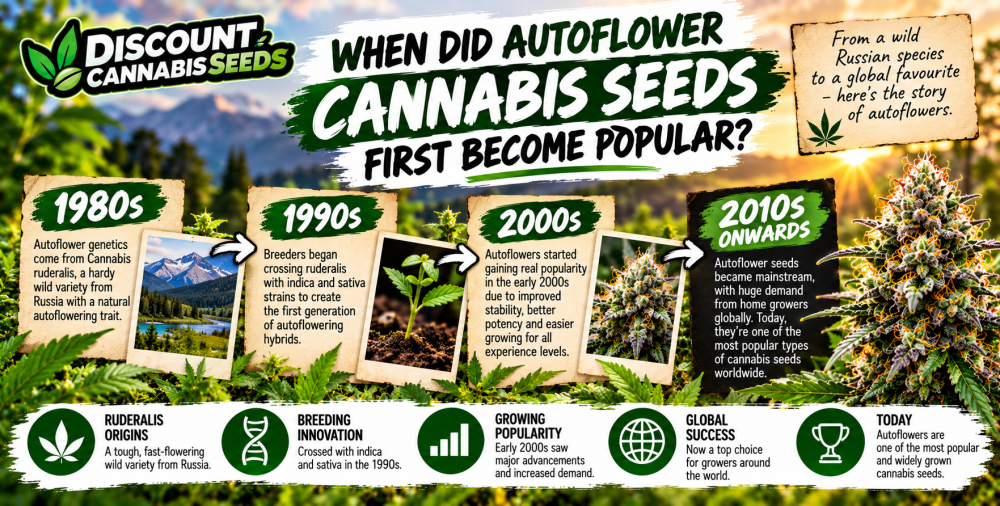
When Did Autoflower Cannabis Seeds First Become Popular?
The modern story can be divided into three broad periods:
Early 2000s — The breakthrough.
The Joint Doctor's Lowryder reached the commercial market around 2003 and demonstrated that stable autoflower cannabis seeds had genuine commercial potential. Fast Buds
Mid-to-late 2000s — The development period.
More breeders began working with autoflower genetics, including established European cannabis seed companies. Genetic choice and commercial acceptance gradually increased. Leafly
2010s onwards — The mainstream era.
Improved genetics, feminised autoflowers, greater breeder participation and a much wider selection transformed autos into one of the major categories within the cannabis seed industry.
So autoflower cannabis seeds didn't suddenly become popular in one particular year.
Lowryder started the commercial breakthrough in the early 2000s. The following decade turned that breakthrough into a mainstream cannabis seed category.
Explore Autoflower Cannabis Seeds at Discount Cannabis Seeds.
The history of autoflower cannabis seeds is particularly interesting because much of it happened within a relatively short period.
Collectors went from having almost no commercially established autoflower choices to being able to explore hundreds of modern genetic combinations.
At Discount Cannabis Seeds, you can browse autoflower cannabis seeds from established international breeders alongside exclusive DCS autoflower genetics, giving you access to different generations and styles of autoflower breeding within one UK cannabis seed bank.
When comparing autoflower cannabis seeds, don't look only at the strain name.
- Look at the breeder.
- Look at the stated genetics.
- Look at whether it's an established genetic family or a newer release.
- And remember how recently this entire category emerged.
The autoflower market that seems completely normal today can trace its commercial breakthrough back only to the early 2000s — when a tiny strain called Lowryder helped change the direction of cannabis seed breeding.