




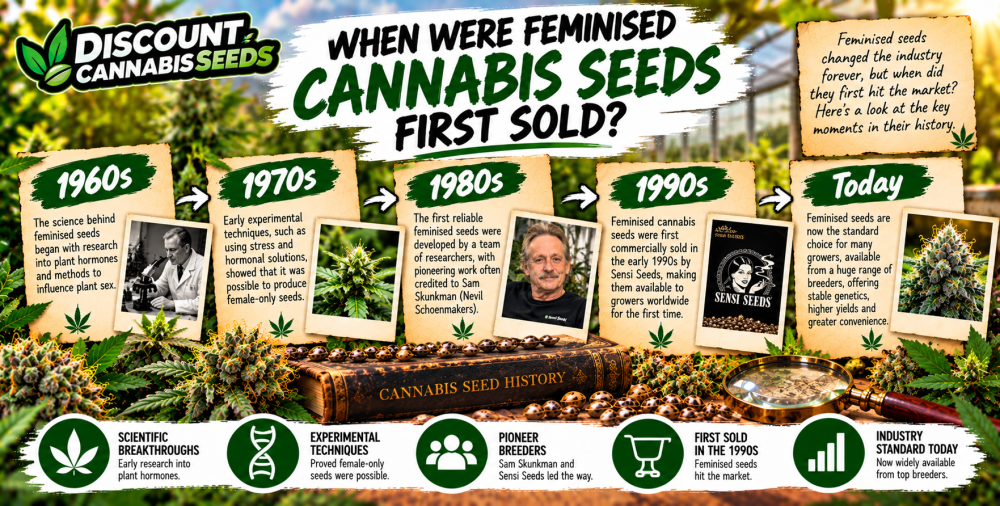
Cannabis Seeds: When Were Feminised Cannabis Seeds First Sold?
Feminised cannabis seeds first became commercially available in the late 1990s. Dutch Passion states that it commercially introduced feminised cannabis seeds in November 1998, following several years of research led by founder Henk van Dalen. By 1996, the company says it had already developed the ability to produce feminised seeds on a controlled, larger scale. Dutch Passion
That makes 1998 an important turning point in cannabis seed history.
Before then, commercial cannabis seed catalogues consisted overwhelmingly of regular seeds. Today, the situation is almost reversed: feminised cannabis seeds dominate many modern breeder catalogues and are one of the largest categories customers encounter at Discount Cannabis Seeds.
But the transition from regular to feminised cannabis seeds didn't happen overnight.
It involved years of experimentation, considerable scepticism and a commercial breakthrough that would eventually change how cannabis seed companies structured their entire catalogues.
What Cannabis Seeds Were Sold Before Feminised Seeds?
For most of the early commercial cannabis seed industry, regular cannabis seeds,
When pioneering seed companies emerged during the 1980s, customers weren't normally choosing between:
- Regular.
- Feminised.
- Autoflower.
- Feminised autoflower.
Those categories developed later.
Dutch Passion, which was formally established in Amsterdam in 1987, states that only regular cannabis seeds were available at that stage of its history. Dutch Passion
That's quite different from browsing Discount Cannabis Seeds today, where collectors can compare feminised cannabis seeds, autoflower genetics, original breeder products and exclusive DCS cannabis seeds from a much broader modern market.
When Did Research Into Feminised Cannabis Seeds Begin?
The important work took place during the early 1990s.
Dutch Passion says its team began researching feminised seed production during this period. Breeder Friedie was involved alongside company founder Henk van Dalen, and by 1996 Dutch Passion says it could produce feminised seeds on a large, controlled scale. Dutch Passion
This gives us a useful timeline:
- Early 1990s: experimentation and research.
- 1996: controlled larger-scale production becomes possible according to Dutch Passion.
- November 1998: Dutch Passion says feminised cannabis seeds were commercially introduced.
- Early 2000s: feminised cannabis seeds become increasingly mainstream.
So although you'll sometimes see 1997 associated with the invention or emergence of feminised seeds, Dutch Passion's more detailed historical account identifies November 1998 as the commercial introduction. Dutch Passion
Who Sold the First Feminised Cannabis Seeds?
The company credited with the commercial breakthrough is Dutch Passion.
Founder Henk van Dalen had already been working with cannabis genetics for years before Dutch Passion formally became a seed bank in 1987.
During the 1990s, his experiments investigated a fascinating characteristic of female cannabis plants.
Dutch Passion describes discovering that female plants left for sufficiently long periods could eventually produce small numbers of male flowers. Pollen collected from those flowers was then used in experiments that produced female offspring. Dutch Passion
The company subsequently developed the process into something that could be used commercially.
That work ultimately created a completely new cannabis seed category.
What Were the First Feminised Cannabis Seeds Like?
The earliest feminised seeds weren't produced as easily or efficiently as modern commercial seed batches.
Dutch Passion explains that its initial process relied on obtaining small quantities of what it called "female pollen". Collecting sufficient pollen was difficult, making production relatively limited. Dutch Passion
That meant the earliest feminised cannabis seeds were initially available only in small quantities.
This is important because it explains why there isn't one moment where every cannabis seed catalogue suddenly switched from regular to feminised.
The first commercial seeds appeared.
- Customers tried them.
- Demand increased.
- Production methods improved.
- Other breeders became interested.
And the market gradually changed.
Did the First Feminised Cannabis Seeds Sell Well?
According to Dutch Passion, yes.
The company says its first feminised seeds quickly sold out and demand increased dramatically. Dutch Passion
That's particularly interesting because the concept wasn't universally accepted at first.
Today, seeing Feminised beside a cannabis seed product seems completely ordinary.
In 1998, it wasn't.
Many people within the cannabis community had spent years assuming regular cannabis seeds were simply how seed-grown cannabis worked commercially.
A seed product designed to produce overwhelmingly female offspring represented something fundamentally different.
Were People Sceptical About Feminised Cannabis Seeds?
Very much so.
Dutch Passion says some people initially refused to believe reliable feminised cannabis seeds were possible. Dutch Passion
- That's understandable when you consider the context.
- There wasn't an established feminised cannabis seed market to compare them with.
- There weren't dozens of breeders offering feminised genetics.
- There weren't thousands of customer reviews online.
There wasn't a huge category of feminised cannabis seeds at retailers such as Discount Cannabis Seeds.
- It was a genuinely new commercial product.
- The market had to become comfortable with it.
Why Did Feminised Cannabis Seeds Become Popular So Quickly?
They offered something customers clearly wanted: greater predictability from the seed type they were purchasing.
Once people gained confidence in feminised seeds, demand increased rapidly.
Dutch Passion says feminised seeds eventually came to account for around 97% of its own seed sales, although that's a company-specific figure rather than a measurement of the entire global cannabis seed industry. Dutch Passion
The important point isn't the precise percentage.
It's how dramatically the market changed.
Within a relatively short period, the product that had been controversial in the late 1990s became the standard choice across large parts of the commercial cannabis seed industry.
When Did Other Cannabis Seed Breeders Start Selling Feminised Seeds?
As demand became obvious, feminised genetics spread throughout the industry.
Breeders that had historically offered regular cannabis seeds began adding feminised versions.
Newer seed companies entered a market where feminised genetics were increasingly expected.
Over time, the distinction became so established that modern cannabis seed banks normally make Regular, Feminised and Autoflower clearly identifiable product categories.
You can see the result of that evolution when browsing Discount Cannabis Seeds today.
Instead of feminised cannabis seeds being one experimental product from one pioneering company, collectors can compare feminised genetics from numerous international breeders.
Did Famous Old Cannabis Strains Become Feminised?
Yes, and this helped connect the old and new eras of cannabis breeding.
Many famous cannabis strains existed before feminised cannabis seeds were commercially available.
Their original commercial seed versions were therefore regular.
After feminisation became established, breeders could introduce feminised versions associated with existing genetic lines.
This meant an older strain didn't necessarily have to disappear simply because the seed market was changing.
Its format could evolve.
That's one reason classic strain names remain visible alongside completely modern genetics in today's Discount Cannabis Seeds catalogue.
Were Feminised Seeds Available in the 1980s?
Not as the established commercial cannabis seed category we recognise today.
This is an important point because many famous breeders and strains pre-date feminisation.
Sensi Seeds dates to 1985.
Barney's Farm traces its establishment to 1986.
Dutch Passion was formally established in 1987.
The commercial seed industry was already developing before feminised cannabis seeds arrived.
Dutch Passion's own timeline specifically says that when it was established in 1987, only regular cannabis seeds were available. Dutch Passion
Feminised seeds therefore belong primarily to the late-1990s transformation of the cannabis seed industry, rather than its original 1980s commercial beginnings.
Were Feminised Cannabis Seeds Available in the Early 1990s?
This is where the distinction between experimental and commercially available becomes important.
Research was happening.
Dutch Passion says experimentation began in the early 1990s. Dutch Passion
But that doesn't mean someone could browse a normal cannabis seed catalogue in 1991 and find a huge feminised section.
The commercial product followed later.
This is why saying simply "feminised seeds were invented in the 1990s" is correct but incomplete.
A more useful historical explanation is:
They were researched during the early 1990s, became scalable during the middle of the decade and were commercially introduced towards the end of the 1990s.
Why Is 1996 Important?
Because Dutch Passion identifies 1996 as the point when it could produce feminised cannabis seeds on a large, controlled scale. Dutch Passion
That's an important step between discovery and commercialisation.
Producing a small experimental batch is one thing.
Creating sufficient reliable seed stock for a commercial seed company is another.
The years between the first experiments and the eventual commercial launch were therefore essential.
Without scalable production, feminised cannabis seeds might have remained an interesting breeding experiment rather than becoming an international product category.
Why Is November 1998 Important?
Because Dutch Passion's detailed account specifically states that feminised cannabis seeds were commercially introduced in November 1998. Dutch Passion
For SEO and historical accuracy, this is the date worth remembering.
If somebody asks:
When were feminised cannabis seeds invented?
During the 1990s.
When could they be produced commercially at scale?
Dutch Passion says 1996.
When were feminised cannabis seeds first commercially introduced?
Dutch Passion says November 1998.
Those are different milestones rather than contradictory dates.
What Did Cannabis Seed Catalogues Look Like Before 1998?
They were dramatically simpler in terms of seed type.
The important choices revolved much more around breeders, strains and genetic families.
Regular seeds dominated.
There wasn't a huge separate autoflower market either — the commercial autoflower breakthrough would arrive later, during the early 2000s.
So a late-1990s cannabis seed catalogue sat at an interesting transition point.
- The old regular-seed era was still dominant.
- Feminisation was just arriving.
- Autoflowers hadn't yet become mainstream.
Modern American genetic families hadn't transformed European catalogues.
The seed market we recognise today was only beginning to take shape.
Which Came First: Feminised or Autoflower Cannabis Seeds?
Commercial feminised cannabis seeds came first.
Dutch Passion places its commercial feminised introduction in 1998. Dutch Passion
The modern commercial autoflower movement accelerated several years later in the early 2000s.
This means the evolution broadly looks like:
- 1980s – regular cannabis seeds dominate.
- 1990s – feminised seed research develops.
- 1998 – commercial feminised cannabis seeds appear.
- Early 2000s – the modern autoflower movement begins accelerating.
- Later 2000s/2010s – feminised autoflowers become increasingly established.
Today all of these stages can be seen together within modern cannabis seed catalogues such as Discount Cannabis Seeds.
When Did Feminised Autoflower Cannabis Seeds Appear?
Later than standard feminised photoperiod seeds.
Feminised autoflowers required two innovations to come together:
Reliable feminisation and reliable autoflowering genetics.
Dutch Passion later collaborated with The Joint Doctor during the early development of mainstream autoflower genetics. The company describes subsequent generations of feminised autoflower seeds as an important part of that development. Dutch Passion
This eventually produced the modern situation where many cannabis seeds described simply as "Auto" are also feminised.
For collectors browsing autoflower cannabis seeds at Discount Cannabis Seeds, that's worth remembering: autoflower and feminised aren't opposites.
A cannabis seed can be both.
Did Feminised Cannabis Seeds Replace Regular Seeds Completely?
No.
Regular cannabis seeds still exist and remain relevant, particularly within breeding collections and among people specifically seeking regular versions of genetics.
Dutch Passion itself continues to sell regular seeds despite being the company that claims the commercial feminisation breakthrough. Dutch Passion
But the balance changed enormously.
What had once been the default became a specialist category.
What had once been experimental became mainstream.
Few developments demonstrate the evolution of the cannabis seed industry more clearly.
Are Modern Feminised Cannabis Seeds the Same as Those Sold in 1998?
The basic concept is connected, but commercial techniques and genetics have continued developing.
Dutch Passion says methods of feminised seed production were subsequently refined and became more reliable and consistent. Dutch Passion
At the same time, the genetics available in feminised form expanded enormously.
The first commercial feminised market was limited.
Today's market includes:
- Classic cannabis genetics.
- Modern hybrids.
- American genetic families.
- CBD-focused genetics.
- Autoflowering varieties.
- Breeder exclusives.
- And numerous newer genetic categories.
- The word feminised remained.
- Everything surrounding it expanded.
Does Feminised Describe the Genetics of a Cannabis Strain?
No.
This is an important distinction when comparing products at Discount Cannabis Seeds.
Feminised describes the seed type, not one particular genetic family.
Two feminised cannabis seeds can have completely different ancestry.
One could represent an old-school genetic line whose history reaches back decades.
Another could be a completely modern hybrid released this year.
Both can still be feminised.
That's why customers should consider the breeder, strain, stated lineage and seed type together rather than treating "feminised" as a description of the complete genetics.
Why Does the Breeder Matter With Feminised Cannabis Seeds?
Because today's feminised seed market contains products from many different breeders.
Dutch Passion's historical importance doesn't mean every feminised cannabis seed comes from Dutch Passion.
Once the technology became established, feminisation spread throughout the industry.
Breeders developed their own collections and methods.
Today, Discount Cannabis Seeds brings together feminised cannabis seeds from numerous established and modern breeders, allowing collectors to compare genetics without being restricted to one company's catalogue.
That makes the modern market completely different from the late 1990s, when feminised cannabis seeds were still a novelty.
Can You Still Buy Feminised Seeds From the Company That Introduced Them?
Yes.
Dutch Passion remains active today and continues to sell feminised genetics.
The company was formally established in 1987 and describes feminised cannabis seeds as one of the major innovations in its history. Dutch Passion
For collectors interested in cannabis seed history, that makes Dutch Passion particularly interesting.
It's possible to explore genetics from a company that was selling regular cannabis seeds before commercial feminisation existed and subsequently helped transform the market by introducing the new seed type.
Discount Cannabis Seeds carries products from long-established breeders alongside newer seed companies, making it possible to explore different eras of cannabis breeding within one multi-breeder seed bank.
How Long Have Feminised Cannabis Seeds Been Sold?
If we use Dutch Passion's November 1998 commercial introduction as the key milestone, feminised cannabis seeds have now been commercially available for nearly three decades. Dutch Passion
That's long enough for an entire generation of cannabis seed customers to have grown up knowing feminised seeds as completely normal.
But compared with the much longer history of cannabis itself, they're remarkably recent.
Someone browsing a seed catalogue in 1988 wouldn't have encountered the huge feminised categories we take for granted today.
Ten years later, that was beginning to change.
How Did Feminised Seeds Change Cannabis Seed Banks?
Perhaps their biggest impact was creating choice by seed type.
Before feminisation, the seed itself wasn't divided into the same commercial categories we see today.
Once feminised cannabis seeds succeeded, customers increasingly expected to know precisely what type of seed they were purchasing.
Later, autoflowers added another major category.
Modern cannabis seed banks therefore organise products using combinations of:
- Breeder.
- Strain.
- Seed type.
- Genetic family.
- Pack size.
- And other characteristics.
Browse Discount Cannabis Seeds today and this structure feels normal.
Historically, it's the result of several decades of innovation.
How Did Feminised Seeds Influence Modern Cannabis Breeders?
- They changed expectations.
- Once customers became accustomed to feminised versions, breeders had a commercial incentive to make new genetics available in that format.
- Older strains could be revisited.
- New hybrids could be launched as feminised products.
- Entire breeders could concentrate predominantly on feminised genetics.
- Eventually, some companies stopped offering many regular versions altogether.
Dutch Passion says feminised seeds became the overwhelming majority of its own sales within only a few years. Dutch Passion
That's an extraordinary market shift for something that had barely existed commercially at the beginning of the decade.
Can You Buy Feminised Cannabis Seeds From Different Breeders at Discount Cannabis Seeds?
Yes. This is where the history connects directly with today's cannabis seed market.
Discount Cannabis Seeds brings together cannabis seeds from numerous international breeders, including companies whose histories stretch back before feminised cannabis seeds existed and newer breeders that entered the market after feminisation had become standard.
Collectors can explore feminised genetics from established names such as Dutch Passion, Barney's Farm, Green House Seeds, Royal Queen Seeds, Sweet Seeds and Anesia, alongside the exclusive DCS cannabis seed collection.
That allows you to compare different breeders, genetic families and generations of cannabis seed development within one catalogue.
Why Is Dutch Passion Important When Browsing Feminised Cannabis Seeds?
Because its name represents more than another modern breeder.
Dutch Passion existed before commercial feminised cannabis seeds.
It conducted research during the period in which the concept was being developed.
It says it achieved controlled larger-scale production by 1996.
And it identifies November 1998 as the commercial introduction. Dutch Passion
So when you encounter Dutch Passion alongside other breeders at Discount Cannabis Seeds, you're looking at a company directly connected to one of the major changes in commercial cannabis seed history.
When Were Feminised Cannabis Seeds First Sold?
The clearest documented answer is:
Dutch Passion says feminised cannabis seeds were commercially introduced in November 1998. Dutch Passion
- The development didn't happen overnight.
- Research had begun earlier in the 1990s.
- Controlled larger-scale production was possible by 1996.
- Commercial sales followed towards the end of the decade.
- Demand then increased rapidly and other cannabis seed breeders adopted feminisation.
Within a few years, a product that had initially been met with scepticism was transforming the commercial cannabis seed market.
Explore Feminised Cannabis Seeds at Discount Cannabis Seeds.
The history of feminised cannabis seeds is a reminder of just how much the seed industry has changed in less than 30 years.
Before the late 1990s, regular cannabis seeds dominated commercial catalogues.
Today, feminised genetics extend across classic strains, modern hybrids, autoflower varieties and numerous international breeder collections.
At Discount Cannabis Seeds, collectors can explore feminised cannabis seeds from multiple established breeders alongside exclusive DCS genetics, making it possible to compare both modern releases and genetic families with much longer histories.
And when you see hundreds of products marked Feminised, remember how recently that became possible commercially.
According to Dutch Passion's documented history, the commercial story began in November 1998 — and within a few years, the cannabis seed market would never look the same again.