




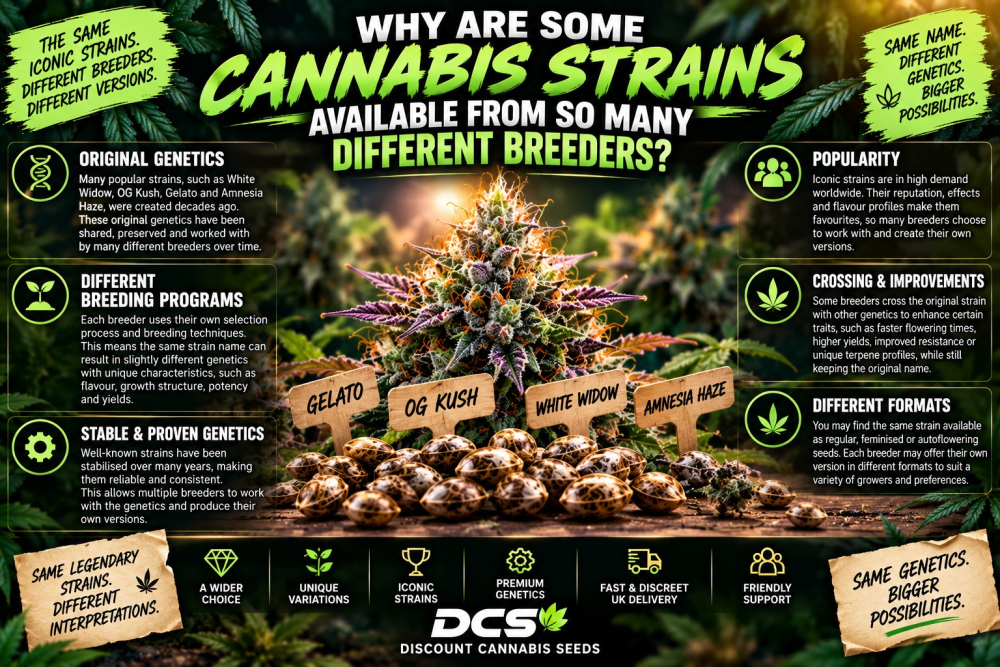
Cannabis Seeds: Why Are Some Cannabis Strains Available From So Many Different Breeders?
Search for a famous cannabis strain and you may find something surprising: the same strain name can appear in the catalogues of numerous different cannabis seed breeders.
Northern Lights, White Widow, Amnesia Haze, Blueberry, Cheese and many other established names are available from multiple seed companies.
But does that mean every breeder is selling exactly the same genetics?
Not necessarily.
The explanation lies in the history of cannabis breeding, genetic selection, strain popularity and the way individual breeders develop their own versions of established varieties.
Famous Cannabis Genetics Spread Between Breeders.
When a cannabis strain becomes particularly successful, its genetics can influence breeding far beyond the company or breeder originally associated with it.
Over time, other breeders may work with:
Related genetic lines.
Selected parent plants.
Descendants of the original genetics.
Similar crosses.
Their own breeding selections.
Recreated versions of older varieties.
This is why successful genetics can eventually appear throughout the wider cannabis seed industry.
A strain can effectively develop into a genetic family rather than remaining one individual product.
The Same Name Doesn't Always Mean the Same Genetics.
This is one of the most important things for collectors to understand.
Two cannabis seed packs carrying the same strain name aren't automatically genetically identical.
Imagine two breeders both selling a variety called Northern Lights.
One breeder may have maintained its own Northern Lights breeding line for decades.
Another may have developed a modern interpretation using related genetics.
A third could have crossed selected Northern Lights genetics and then worked through several generations to create its own version.
The packets may carry the same familiar name, but their precise genetic history can differ.
Breeders Make Their Own Selections.
Breeding involves selection.
Even when breeders begin with related genetic material, they may select for different characteristics over successive generations.
One breeder's priorities may therefore differ considerably from another's.
Over time, these selections can create noticeable differences between versions of a strain.
This is one reason the breeder name is an important part of a cannabis seed's identity.
Instead of looking only at:
White Widow
it can be more useful to think:
White Widow by a particular breeder.
That identifies the actual version being collected.
White Widow Is a Perfect Example.
White Widow became one of the defining names of the 1990s cannabis seed industry.
Its enormous popularity meant the name eventually appeared across numerous breeder catalogues.
Today, collectors can encounter multiple versions of White Widow from different seed companies.
The same is true of many other established varieties.
Examples include:
Northern Lights.
Amnesia Haze.
Blueberry.
Critical.
Cheese.
Skunk.
AK-47-style genetics.
OG Kush.
Sour Diesel.
These names have become part of the wider language of cannabis genetics rather than being encountered in only one catalogue.
Some Strains Become Genetic Categories.
Occasionally a strain becomes so influential that its name starts describing a wider family of genetics.
Haze is a good example.
Today there are numerous Haze-related varieties, including Amnesia Haze, Super Silver Haze, Lemon Haze and many other hybrids.
The same phenomenon can be seen with:
Kush.
Skunk.
Cookies.
Gelato.
Gorilla.
Runtz.
These names can represent enormous genetic families containing many individual varieties.
This makes modern cannabis genetics considerably more complicated than simply matching a strain name.
Original Genetics vs Modern Interpretations.
Older strains create another challenge.
If original breeding material has been maintained, a breeder may be able to continue producing a variety closely connected to an established genetic line.
But breeding stock can also disappear.
Parent plants can be lost, breeders can close, seed collections can vanish and genetic lines can change over time.
When that happens, another breeder may attempt to recreate the characteristics associated with the original strain using available genetics.
That doesn't necessarily make the newer version inferior.
It simply means its genetic history may be different.
For collectors interested in provenance, this distinction can be important.
Why Do Breeders Use Famous Strain Names?
Recognition plays an obvious role.
Someone browsing cannabis seeds is far more likely to recognise Northern Lights than an entirely unfamiliar strain name.
Established names already have:
A history.
A reputation.
Collector recognition.
Genetic associations.
Search demand.
However, the use of a familiar name doesn't automatically prove that two products share precisely the same lineage.
This is why researching the breeder and product description is worthwhile.
Modern Genetics Are Experiencing the Same Thing.
This isn't limited to older strains.
The same process can happen remarkably quickly with modern genetics.
Once a genetic family becomes popular, breeders begin creating related hybrids and their own interpretations.
Modern catalogues now contain numerous varieties connected to:
Gelato.
Cookies.
Zkittlez.
Runtz.
Gorilla.
Sherbet.
Cake.
Kush.
A successful strain can therefore influence dozens—or eventually hundreds—of later products.
Autoflower Versions Add Another Layer.
Modern breeder catalogues also contain autoflower interpretations of famous genetics.
A classic or modern photoperiod variety may later inspire an autoflower version.
This means collectors might encounter:
Original strain name.
Feminised version.
Autoflower version.
Fast-flowering version.
Related hybrids.
They may share a name or genetic influence without being identical products.
Checking the full product information becomes particularly important when comparing these versions.
How Can Collectors Compare Different Versions?
Rather than relying solely on the name printed on the packet, look at several pieces of information.
Check the Breeder.
Identify exactly which breeder produced the seeds.
Check the Stated Genetics.
Look for information about the parent varieties or genetic lineage.
Read the Product Description.
Breeders often explain how their particular version was developed.
Check the Seed Type.
Make sure you're comparing like with like, particularly when feminised and autoflower versions exist.
Look at the Original Packaging.
Official breeder packaging helps identify exactly which breeder's version you have.
These details provide much more information than the strain name alone.
Why Original Breeder Packs Matter.
This is also one reason original breeder packs can be interesting to collectors.
The packaging connects the strain directly with the company that produced that particular release.
If several breeders offer White Widow, for example, keeping the original packaging makes it immediately clear which version belongs to which breeder.
Packaging can also contain:
Breeder branding.
Product codes.
Genetic information.
Pack sizes.
Authenticity features.
Batch or production information.
For a collection containing several versions of famous genetics, this can be particularly useful.
Compare Cannabis Seed Breeders at Discount Cannabis Seeds.
One advantage of shopping across multiple breeders is the ability to compare different interpretations of established genetics in one place.
At Discount Cannabis Seeds, our collection includes products from leading breeders such as:
Barney's Farm.
Dutch Passion.
Royal Queen Seeds.
Green House Seeds.
Humboldt Seed Company.
Fast Buds.
Sweet Seeds.
Original Sensible Seeds.
DNA Genetics.
Paradise Seeds.
Serious Seeds.
Ministry of Cannabis.
You can explore individual breeder collections as well as compare feminised, autoflower, classic, modern and exclusive genetics.
Explore Famous Genetic Families.
If you're interested in seeing how genetics develop across different breeders, start with some of the industry's biggest genetic families.
Explore:
Haze cannabis seeds.
Kush cannabis seeds.
Cheese cannabis seeds.
Skunk cannabis seeds.
Cookies cannabis seeds.
Gelato cannabis seeds.
Runtz cannabis seeds.
Gorilla cannabis seeds.
Zkittlez cannabis seeds.
These collections can reveal just how differently breeders interpret and develop genetics connected to the same famous families.
The Breeder Is Part of the Strain's Identity.
When comparing cannabis seeds, the strain name is only the beginning.
Breeder, lineage, generation, seed type and selection history can all influence what sits inside the packet.
That's why seeing the same famous name offered by several breeders isn't necessarily duplication.
Each product may represent a different branch of the same genetic family tree.
For collectors, that can actually make established strains more interesting: instead of collecting only a famous name, you can explore how different breeders have preserved, interpreted and developed those genetics over time.
Explore cannabis seed breeders, famous genetic families and thousands of different varieties at Discount Cannabis Seeds.