




Cannabis Seeds: Why Do Cannabis Strains Have Different Genetics?
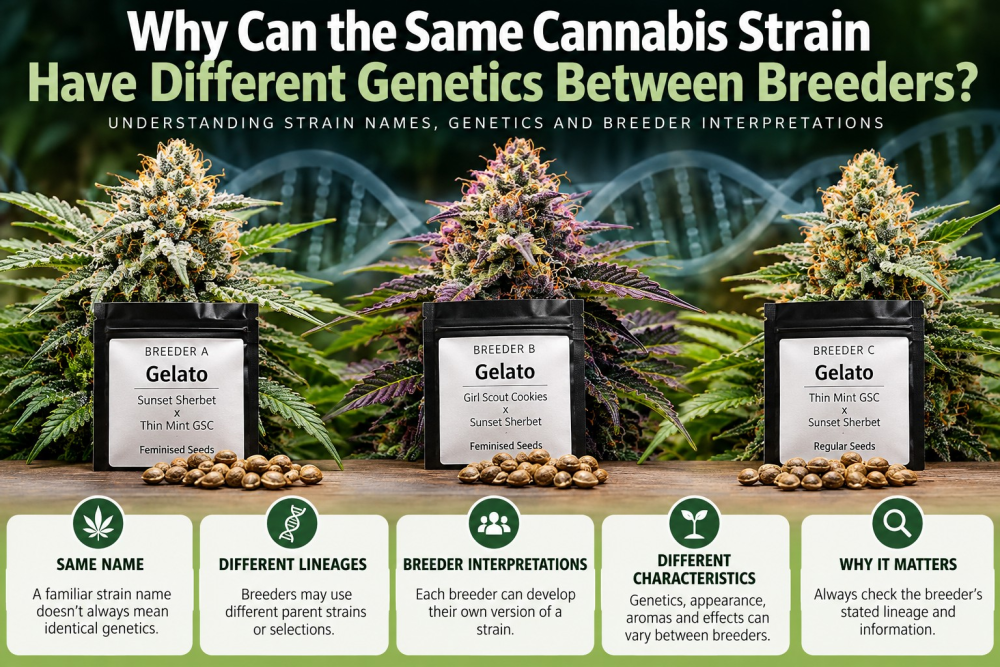
When browsing cannabis seeds from different breeders, collectors may notice something confusing: the same strain name can sometimes appear with different parent genetics, descriptions or genetic backgrounds.
Two seed banks might both offer a strain carrying a familiar name, yet when you compare the breeder information, the stated lineage isn't necessarily identical.
So how can that happen?
The answer lies in the way cannabis strains are developed, selected, named and interpreted by different breeding programmes.
Understanding these differences can help collectors look beyond a strain name and pay closer attention to the breeder, parent genetics and documented lineage behind a particular pack of cannabis seeds.
A Strain Name Doesn't Always Tell the Whole Story.
Cannabis strain names are useful identifiers, but they shouldn't always be treated as precise genetic definitions.
Well-known names such as Kush, Haze, Cookies, Gelato and Runtz have developed into enormous genetic families containing many related varieties.
As those genetics have been used in different breeding programmes, breeders have created their own crosses, selections and interpretations.
This means the name printed on a seed pack is only one part of its identity.
For collectors comparing cannabis seeds, it's worth looking at:
Information What It Tells You
Breeder Who produced the seeds.
Parent strains The stated genetics used to create the variety.
Genetic family The wider lineage the strain belongs to.
Generation Where supplied, this can provide additional information about the breeding line.
Seed type Whether the seeds are feminised, regular, autoflower or another type.
Original breeder information The specifications supplied by the breeder themselves.
Why Do Different Breeders Sometimes Use the Same Strain Name?
There isn't one single explanation.
Cannabis genetics have been exchanged, selected and developed by breeders around the world for decades. As famous genetic families have expanded, names have sometimes travelled much further than the original breeding lines behind them.
A breeder may work with a particular selection of a famous genetic line while another breeder works with a different selection.
They may subsequently produce seeds with similar or identical names.
That doesn't automatically mean either product is incorrectly named. It means the breeder behind the seeds matters.
Different Parent Selections Can Produce Different Breeding Lines.
Even when breeders begin with related genetic material, their breeding programmes can take different directions.
Individual selections may be chosen for particular characteristics before being incorporated into later generations.
Over time, separate breeding projects can therefore diverge.
This is one reason collectors shouldn't assume that:
Same name = genetically identical cannabis seeds.
Instead, think of the strain name as the starting point for your research.
The breeder and stated lineage provide considerably more context.
Genetic Families Make This Even More Complicated.
Modern cannabis genetics contain several enormous families.
Kush has influenced an extraordinary number of varieties.
The wider family includes names associated with Hindu Kush, OG Kush, Master Kush, Bubba Kush and numerous modern Kush hybrids.
Therefore, simply seeing “Kush” in a strain name doesn't identify one exact genetic combination.
Haze is another huge family.
Decades of breeding have produced numerous Haze-related varieties, with different breeders combining Haze lines with other genetics.
Cookies genetics became enormously influential in modern breeding and subsequently contributed to numerous newer families.
The DCS genetics database, for example, identifies Cookies-related lines including Gelato, Jealousy and Permanent Marker.
These are comparatively modern examples of genetic names that rapidly expanded into much larger families.
Breeders around the world have subsequently created varieties incorporating these genetics, resulting in numerous related but distinct seed lines.
The Breeder Name Is Important.
Imagine you find the same strain name listed by three different breeders.
Rather than assuming all three packs contain exactly the same genetic line, compare them individually.
Look at:
Breeder A
Stated parent genetics.
Genetic classification.
Seed type.
Breeder description.
Then compare those details with Breeder B and Breeder C.
Sometimes the stated lineage will be extremely similar.
Sometimes there may be meaningful differences.
That's why Discount Cannabis Seeds displays the breeder alongside individual varieties: the breeder is part of the identity of the product.
Original Genetics and Breeder Interpretations.
Some strain names have particularly well-documented origins.
As those strains become influential, other breeders may use related genetics to develop new versions, crosses or selections.
Collectors may therefore encounter:
Original or historically associated lines.
Genetics closely connected with the strain's recognised breeding history.
Breeder selections.
A breeder's selection developed from particular genetic material.
Modern interpretations.
Newer breeding projects inspired by or incorporating an established genetic family.
Hybrids and descendants.
New varieties containing the famous genetics as one part of a larger lineage.
These aren't necessarily interchangeable.
Why Parent Genetics Matter More Than a Fancy Name.
Modern cannabis strain names can be extremely creative.
But the name alone may reveal surprisingly little about what's actually behind the seeds.
For somebody interested in genetic heritage, the more useful questions are:
Who bred it?
What parent strains does the breeder state?
What genetic family does it belong to?
Is it an original breeder pack?
Does the breeder provide additional lineage information?
That provides considerably more context than choosing purely because the name is familiar.
Your existing DCS guide on reading cannabis seed genetics makes a similar point: collectors can use parent strains, family trees and breeder information to understand what's behind a variety rather than relying solely on its name.
Can Two Strains Have the Same Name but Different Parent Genetics?
Yes.
When comparing breeder catalogues, you may occasionally find identically or similarly named varieties with different stated parentage.
That's precisely why it's useful to treat breeder + strain + lineage as the complete description rather than looking at the strain name in isolation.
For example:
Strain X — Breeder A
Parent A × Parent B.
Strain X — Breeder B
Parent A × Parent C.
Those shouldn't automatically be treated as genetically identical products simply because both use “Strain X” on the packaging.
Does Different Mean Better or Worse?
Not necessarily.
Different genetics are simply different genetics.
A familiar name doesn't automatically make one breeder's version superior to another, and a different lineage doesn't automatically mean something is inferior.
For collectors, the important thing is transparency.
Clear information about the breeder and stated parentage makes it easier to understand exactly which version you're looking at.
Why Famous Strain Names Become Genetic Families.
Successful strains often influence later breeding projects.
A single important variety can eventually produce numerous descendants.
Those descendants can then become parents themselves.
Over several generations, what began as an individual strain can effectively become an entire genetic family.
Your existing DCS family-tree guide shows this particularly clearly: historic genetics such as Afghan, Skunk, Haze and Kush eventually contributed to extensive networks of modern descendants.
This is why modern cannabis genetics can become complicated very quickly.
A variety may contain influences from several famous families simultaneously.
How to Compare Cannabis Seeds From Different Breeders.
When two products have similar names, don't compare the names alone.
Use this checklist:
1. Check the breeder.
Identify who actually produced each seed pack.
2. Compare the stated parents.
Look for the genetic cross supplied by each breeder.
3. Check the wider family.
See whether both products originate from the same broader genetic family.
4. Check the seed type.
A similarly named autoflower and feminised photoperiod line, for example, shouldn't automatically be treated as identical products.
5. Read the breeder's own information.
Specifications should ultimately be based on information supplied for that particular product.
6. Look beyond percentages.
Simple indica/sativa percentages don't provide a complete genetic history.
7. Don't assume the most familiar name is the original.
Research the breeding history where provenance matters to you.
Original Breeder Packs Can Make Comparison Easier.
Original breeder packaging can be particularly useful to collectors because it clearly associates the seeds with the breeder responsible for that particular release.
Packaging may identify information such as:
Breeder.
Strain.
Seed quantity.
Seed type.
Product or batch information where provided.
Breeder branding.
The exact information varies between breeders.
The important distinction is that you're looking at a specific breeder's product, rather than treating every seed carrying that strain name as identical.
Why Discount Cannabis Seeds Stocks Multiple Breeders.
One advantage of having a large breeder catalogue is choice.
Discount Cannabis Seeds brings together cannabis seeds from numerous established breeders alongside exclusive DCS genetics, allowing collectors to explore different genetic families, breeders and releases in one place.
Rather than assuming every similarly named strain is identical, customers can compare the breeder, stated lineage, seed type and product information before making their selection.
Our collection includes:
Feminised cannabis seeds.
Autoflower cannabis seeds.
Regular cannabis seeds.
Original breeder packs.
Exclusive DCS genetics.
Bulk cannabis seed collections.
Modern hybrids and classic genetic families.
This makes DCS particularly useful for collectors interested in comparing the enormous variety that now exists within modern cannabis genetics.
Frequently Asked Questions.
Can two cannabis strains have exactly the same name?
Yes. Similar or identical names can appear across different breeder catalogues. Always check the breeder and stated lineage rather than relying solely on the name.
Does the same strain name mean the seeds are genetically identical?
Not necessarily. Different breeders may use different selections, parent lines or breeding programmes.
Why do cannabis strain lineages sometimes differ online?
Information can come from different breeders, historical accounts or databases, and some strain histories are disputed or incompletely documented. For a particular seed product, the breeder's stated lineage is usually the most relevant information to consult.
Does the breeder matter when choosing cannabis seeds?
It matters when identifying exactly which product you're looking at. The breeder provides important context about the particular release, lineage and seed type.
What is a cannabis genetic family?
A genetic family is a wider group of related varieties connected through breeding ancestry. Kush, Haze, Skunk, Cookies, Gelato and Runtz are examples of widely recognised families or lineages in modern breeder catalogues.
Why are there so many versions of famous strains?
Influential genetics are repeatedly used in breeding programmes. Over time this produces selections, crosses, descendants and new interpretations associated with the original name or family.
Look Beyond the Strain Name.
Cannabis strain names are useful, but they aren't the entire genetic story.
When comparing cannabis seeds from different breeders, look beyond the label and examine the breeder, stated parents, genetic family and product information.
That's where the interesting differences become visible.
At Discount Cannabis Seeds, collectors can explore thousands of varieties from established breeders alongside exclusive DCS genetics, making it easier to compare classic genetic families with newer breeder releases.