




Cannabis Seeds: Why Are So Many Modern Cannabis Strains Related to Each Other?
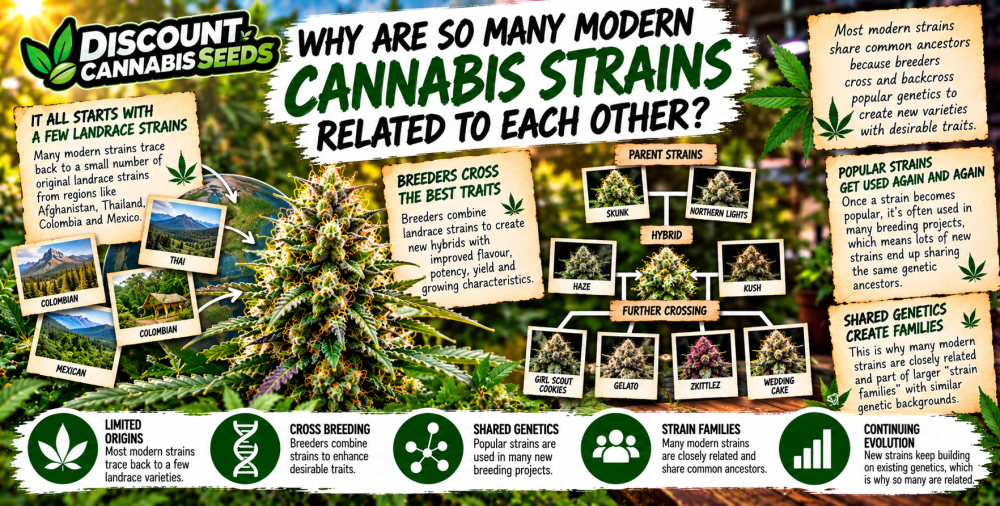
So many modern cannabis strains are related because breeders repeatedly work with successful parent genetics. When a strain becomes particularly influential, it can be crossed into dozens or even hundreds of later varieties. Those descendants are then crossed again, creating large cannabis genetic families that can share ancestors several generations back.
That's why two cannabis strains with completely different names can sometimes turn out to be distant cousins.
Modern cannabis seeds catalogues may contain thousands of different strain names, but their genetic family trees frequently overlap.
At Discount Cannabis Seeds, this becomes particularly noticeable when comparing cannabis seeds from different breeders. Follow the stated parent genetics backwards and familiar names and genetic families can begin appearing again and again.
Are Modern Cannabis Strains Really More Closely Related Than They Look?
Often, yes.
A modern cannabis seed catalogue can create the impression that every strain represents an entirely separate genetic line.
In reality, cannabis breeding works through inheritance.
Breeders select existing genetics and cross them to produce new combinations. Successful descendants can then become parents themselves.
Imagine a fictional strain called Strain A becomes extremely popular.
Breeders might create:
- Strain A × Strain B
- Strain A × Strain C
- Strain A × Strain D
Then somebody might take the first offspring and cross it with another genetic line:
(Strain A × Strain B) × Strain E
A few generations later, Strain A may no longer appear in the new strain's name at all.
But it's still sitting in the family tree.
Multiply that process across decades of cannabis breeding and you begin to understand why the modern genetic landscape is so interconnected.
Why Don't Breeders Just Create Completely New Genetics?
Because cannabis breeders don't normally start from nothing.
New strains are produced from existing genetic material.
A breeder might select parents because of characteristics associated with their lineage, because the genetics complement one another, because a particular parent has proven valuable in previous breeding projects or simply because the breeder wants to explore a new combination.
Successful genetics are particularly likely to be reused.
This isn't unique to cannabis.
Selective breeding in many crops involves repeatedly working with valuable genetic material.
The difference is that cannabis has an enormous commercial naming culture surrounding individual crosses, so every new combination can appear to consumers as an entirely new strain.
What Is a Cannabis Genetic Family?
A cannabis genetic family is a useful informal way of describing groups of strains connected through common ancestry.
Some families become enormous.
For example, if an influential strain is repeatedly used as a parent, its descendants may eventually be crossed with one another and with other major genetic families.
The result can look less like a simple family tree and more like a giant web.
This is something worth considering when browsing cannabis seeds at Discount Cannabis Seeds.
Instead of looking only at the strain name, look at the parents listed by the breeder.
You may discover connections between apparently unrelated cannabis seeds.
Why Are Certain Cannabis Strains Used for Breeding Again and Again?
Success attracts breeders.
When particular genetics gain a strong reputation, other breeders naturally become interested in working with them or related lines.
- This can create a genetic ripple effect.
- One successful parent produces several popular descendants.
- One of those descendants becomes influential in its own right.
- It then produces another generation.
- Before long, the original genetics can appear somewhere in the ancestry of a substantial number of cannabis strains.
- This is how a single influential genetic line can shape the cannabis seed market for decades.
Did This Happen With Old-School Cannabis Genetics?
Absolutely.
Modern genetic overlap isn't a new phenomenon.
Some of the foundations were laid decades ago.
Families associated with Skunk, Haze, Northern Lights, Afghani and Kush genetics became important building blocks within commercial cannabis breeding.
Those genetics were crossed with other lines.
The resulting hybrids were crossed again.
Some descendants became famous enough to establish genetic families of their own.
So when looking at a modern hybrid, its family tree may eventually lead back to cannabis genetics that became internationally important during the 1980s or 1990s.
That's why our cannabis history articles at Discount Cannabis Seeds connect so closely with today's products.
Old genetics didn't necessarily disappear.
Many became ancestors.
How Important Was Skunk #1?
Skunk #1 is a particularly useful example of how influential genetics can spread through generations of cannabis breeding.
Rather than remaining simply one historic strain, Skunk genetics became incorporated into numerous subsequent breeding projects.
Eventually, "Skunk" became one of the most recognisable words in cannabis.
Its genetic influence extended well beyond products carrying Skunk directly in their names.
This is one reason researching cannabis ancestry can be surprising.
A modern strain doesn't have to say Skunk on the packet for older Skunk-related genetics to potentially appear somewhere further back in its reported lineage.
What Happened With Haze Genetics?
Haze followed a similar pattern.
Original Haze became an influential genetic foundation, but the story didn't stop with one strain.
- Haze genetics were combined with other important families.
- Those hybrids subsequently became parents themselves.
- Over time, numerous branches emerged.
- This is why there are so many cannabis strains containing Haze somewhere in their name or reported ancestry.
- They aren't necessarily the same cannabis strain.
They represent different branches of an interconnected genetic family.
When comparing Haze-related cannabis seeds through Discount Cannabis Seeds, the breeder and complete stated lineage can therefore be more informative than the word Haze alone.
What About Kush Genetics?
Kush makes the picture even more complicated.
The word has deep historical associations with cannabis populations connected to the Hindu Kush region, but it subsequently became incorporated into numerous commercial cannabis strain names and genetic families.
Later, famous American Kush-associated genetics further expanded the name's influence.
As breeders crossed those genetics with other lines, Kush ancestry spread into many modern hybrids.
Today, two products containing the word Kush may have quite different immediate parents.
Again, the shared name doesn't automatically make them identical.
Then American Cannabis Genetics Changed the Family Tree.
The cannabis genetic landscape continued evolving.
As North American genetics became increasingly influential internationally, a new generation of parent strains began appearing repeatedly in breeding projects.
Families associated with OG, Diesel, Cookies, Gelato and later dessert and candy-style genetics became increasingly prominent.
These didn't completely replace older genetic families.
They were often added to them.
That's important.
Modern cannabis genetics aren't simply:
Old strains → replaced by new strains.
They're more like:
Old genetics → hybrids → new influential genetics → further hybrids → modern genetic families.
Every generation adds another layer.
Why Did Cookies Genetics Become So Influential?
- Cookies provides an excellent modern example of the same process.
- Once Cookies-related genetics gained enormous recognition, breeders began using them in new combinations.
- Descendants subsequently became influential themselves.
- Those descendants were then crossed again.
As a result, Cookies ancestry spread through a substantial part of the modern cannabis genetics market.
The word "Cookies" doesn't even need to appear in the eventual strain name.
Several generations later, the genetic connection may only become apparent when you trace the reported family tree backwards.
This is why a modern cannabis strain can look completely new from its name while still having very familiar ancestry.
What About Gelato?
Gelato demonstrates the process particularly well because it became both a famous strain name and a huge source of subsequent breeding material.
- Different selections became known, including numbered Gelato selections.
- Breeders then incorporated Gelato-related genetics into numerous crosses.
- Some descendants became successful enough to produce further descendants of their own.
- Eventually, Gelato stopped being simply one famous cannabis strain.
- It became part of a much wider genetic network.
This is one reason you'll encounter Gelato-related cannabis seeds from different breeders when exploring large collections such as Discount Cannabis Seeds.
They're not necessarily duplicates.
They can represent different branches of the broader genetic family.
Why Are There So Many Runtz Crosses?
- The same cycle happened again with Runtz.
- When particular genetics become commercially fashionable, breeders have an obvious incentive to explore them.
- New crosses appear.
- Some retain the famous parent's name.
- Others receive completely new names.
- Successful descendants may then be used as parents.
That's how modern cannabis genetics can expand extraordinarily quickly while still drawing repeatedly from a smaller group of influential ancestors.
Does a Different Strain Name Mean Different Genetics?
Not completely.
- Different names can represent closely related cannabis strains.
- For example, two products could have completely different names while sharing one parent.
- Another pair might share a grandparent.
- Others may be related several generations further back.
- This connects directly with another issue we've explored at Discount Cannabis Seeds:
- Cannabis strain names aren't genetic certificates.
- Scientific research supports the need for caution here.
A 2015 genetic study analysing 81 drug-type cannabis samples found that strain names didn't consistently correspond to distinct genetic identities. In 6 of 17 comparisons involving identically named samples, the samples were actually genetically closer to differently named samples than to samples sharing their own name. PLOS
That's quite revealing.
The name on the packet can be useful.
The genetics behind it tell a much deeper story.
Has Cannabis Been Hybridised Too Much to Separate Everything Clearly?
Cannabis has experienced extensive hybridisation.
A 2021 genomic study examining commercial cannabis strains noted that large-scale, extensive and often undocumented hybridisation over several decades has made traditional strain classifications increasingly unreliable. PLOS
That's particularly important when people imagine cannabis genetics as neat, separate boxes.
- The real picture is much messier.
- Genetics have travelled internationally.
- Breeders have exchanged material.
- Plants have been selected.
- Strains have been crossed.
- Those hybrids have been crossed again.
- Names have changed.
- Breeding records haven't always survived.
Consequently, modern cannabis genetics form an extremely interconnected network.
Why Is Cannabis Breeding History So Difficult to Trace?
For much of the industry's history, cannabis breeding wasn't operating within the kind of formal systems used for conventional agricultural crops.
There wasn't one worldwide registry recording every cannabis cross.
Breeders sometimes worked privately.
- Genetics moved between countries.
- Clones changed hands.
- Seed stock was exchanged.
- Some breeders kept excellent records.
- Others didn't.
- Companies disappeared.
- Strains were renamed.
And prohibition meant much breeding activity took place outside conventional agricultural research systems.
Researchers studying cannabis genetics have specifically highlighted this problem. Genetic analyses have found examples of identically named cannabis accessions being genetically distinct and differently named accessions appearing genetically identical. PLOS
That's why cannabis family trees should sometimes be treated as reported pedigrees, rather than unquestionable historical records.
Are Sativa and Indica Useful for Understanding These Relationships?
Not as much as many people assume.
Traditional cannabis descriptions frequently divide strains into sativa, indica and hybrid categories.
But modern genetic research has shown the situation is much more complicated.
The 2015 study of cannabis population genetics found only a moderate relationship between reported sativa/indica ancestry and actual genetic structure. PLOS
A later study of commercially available Canadian cannabis similarly concluded that extensive historical hybridisation has made conventional sativa/indica naming unreliable for genetically classifying modern strains. PLOS
For collectors interested in ancestry, the actual breeder-reported parents can therefore be much more informative than simply seeing "hybrid" written on a product description.
Can Two Breeders Use the Same Parent Strain and Produce Different Results?
Yes.
Shared ancestry doesn't make two strains identical.
Imagine two breeders both use the same famous parent.
Breeder A creates:
Famous Parent × Genetic A
Breeder B creates:
Famous Parent × Genetic B
The resulting strains are related through their shared parent, but they're obviously not the same cross.
Even if two breeders use apparently identical parent names, their exact breeding material and selections may differ.
This is another reason the breeder name matters when buying cannabis seeds.
At Discount Cannabis Seeds, customers can browse genetics from multiple breeders, making it possible to compare how different companies work with related genetic families.
Can Two Strains Have the Same Parents and Still Be Different?
Potentially, yes.
A cross isn't necessarily a single genetically identical outcome.
Cannabis contains genetic variation, and breeders can select different individuals from a population.
Two breeding programmes starting with apparently similar parent lines can make different selections.
That means a written lineage is extremely useful, but it still isn't equivalent to a complete DNA profile.
This becomes particularly relevant with famous crosses that have been reproduced or interpreted by more than one breeder.
What Is a Phenotype and Why Does It Matter?
A phenotype is the observable expression produced by the interaction between genetics and environment.
Within a genetically variable seed population, different individuals can display different combinations of inherited characteristics.
Breeders may select a particular individual because it expresses characteristics they're interested in preserving or developing.
If that selection then becomes important breeding material, one branch of a genetic family can begin moving in a different direction from another.
Over generations, these decisions create further diversity within related cannabis genetics.
So being related doesn't mean being identical.
What Is a Backcross?
You'll sometimes encounter BX or "backcross" in cannabis genetic descriptions.
Broadly, backcrossing involves crossing offspring back to a parent or genetically related parental line.
Breeders can use this within breeding programmes when working to reinforce particular inherited characteristics.
From a family-tree perspective, it creates something interesting:
The same ancestor can appear more than once within the pedigree.
This makes cannabis family trees even less like simple human family trees.
A genetic line can loop back towards earlier ancestry.
Can a Cannabis Strain Be Related to Itself More Than Once?
In a pedigree sense, yes.
If an influential genetic line appears through multiple branches of a cross, the same ancestor can occur several times within the extended family tree.
For example, Parent A may itself contain ancestry from Famous Strain X.
Parent B might independently contain Famous Strain X several generations back.
Cross Parent A with Parent B and the resulting offspring receives ancestry connected with Famous Strain X from both sides.
This is one reason simply counting the number of strain names in a pedigree doesn't tell you how genetically diverse the resulting cannabis seeds actually are.
Is Modern Cannabis Becoming Genetically Less Diverse?
This question needs more care than simply answering yes.
Repeatedly using popular breeding material can create concerns about narrowing genetic diversity, particularly if a relatively small number of fashionable lines dominate breeding.
However, the cannabis genetic landscape remains complex, and available research doesn't justify claiming that every modern strain belongs to one narrow gene pool.
Studies have found measurable genetic structure and variation across commercial cannabis. One genomic study identified enough genome-wide variation to separate 23 commercial samples into several genetic groups aligned with different chemotypes. PLOS
So modern cannabis can simultaneously be highly hybridised, interconnected and genetically variable.
Those ideas aren't contradictory.
Why Are Landrace Cannabis Genetics Important?
This is where older geographical populations become particularly interesting.
Before the enormous international hybridisation of modern cannabis, populations developed in different regions under local environmental conditions and human selection.
Genetics associated historically with places such as Afghanistan, Pakistan, India, Thailand, Colombia, Mexico and parts of Africa contributed material that subsequently entered international breeding programmes.
These older populations helped provide the foundations from which many modern genetic families were built.
Once those lines were crossed repeatedly, however, tracing a modern hybrid back to a single geographical origin became increasingly difficult.
Are Landrace Genetics Completely Unrelated?
No.
"Landrace" doesn't mean an entirely separate species with no connection to other cannabis.
It's generally used in cannabis culture for locally adapted populations associated with particular geographical regions and long histories.
Their importance to modern breeding is that they represent older genetic reservoirs from before the enormous amount of international commercial hybridisation that followed.
For collectors interested in cannabis history, this is why old genetic lines can be as fascinating as the newest releases.
Why Don't Breeders Use Landrace Genetics for Every New Strain?
Starting again from older genetic populations isn't necessarily the goal of every breeding project.
Modern breeders may want characteristics already present in developed commercial genetics.
Using an established parent can also provide greater knowledge about the genetic material than beginning with something less commercially developed.
And trends matter.
- If customers are interested in a particular genetic family, breeders have a commercial reason to develop new crosses involving it.
- That's how successful genetics become even more widespread.
- Popularity produces descendants.
- Descendants create more popularity.
Do Cannabis Trends Make Strains More Closely Related?
They certainly encourage repeated use of fashionable genetics.
Cannabis genetics move through trends.
At one time, particular Dutch genetic families dominated seed catalogues.
Later, Kush and Diesel-associated genetics became highly influential.
Then Cookies-related genetics exploded.
Gelato followed.
Candy, dessert and fruit-related genetic families became increasingly visible.
When a particular strain becomes fashionable, numerous breeders may start working with it or its descendants.
That creates a wave of related cannabis strains.
The names might all look new.
The ancestry underneath them can overlap substantially.
Why Do Modern Cannabis Strain Names Make This Hard to See?
Because names increasingly function as brands.
Suppose a breeder crosses two well-known strains and gives the offspring an entirely original name.
Nothing in that new name necessarily reveals either parent.
Another breeder then uses that offspring as a parent and gives its new cross another completely original name.
After only two generations, the original famous ancestor can become invisible unless you examine the lineage.
This is why Discount Cannabis Seeds product descriptions and breeder information can be useful when researching genetics.
Don't stop at the product title.
Follow the family tree.
Are Autoflower Cannabis Strains Related Too?
Yes.
Autoflower cannabis genetics have their own interconnected history.
As covered in our previous Discount Cannabis Seeds guide to the history of autoflower cannabis seeds, the modern commercial autoflower movement developed rapidly after early varieties such as Lowryder demonstrated the potential of stable autoflowering genetics.
Breeders subsequently combined autoflowering characteristics with many established cannabis genetic families.
Those resulting autos were developed further.
Today, autoflower cannabis seeds at Discount Cannabis Seeds cover a huge range of genetic backgrounds.
So autoflowering describes an inherited characteristic.
It doesn't mean all autoflower strains are otherwise genetically identical.
What About Feminised Cannabis Seeds?
The same distinction applies.
As we explored in our Discount Cannabis Seeds guide to the invention of feminised cannabis seeds, feminisation transformed the commercial seed industry during the 1990s.
- But "feminised" isn't a genetic family.
- Feminised cannabis seeds can come from countless different lineages.
- A classic genetic line can be feminised.
- A modern American hybrid can be feminised.
- An autoflower can be feminised.
So when browsing feminised cannabis seeds at Discount Cannabis Seeds, look at the lineage separately from the seed type.
Why Do Breeder Names Matter So Much?
Because breeder information adds context that a strain name alone cannot provide.
- Two breeders might both work with related genetics.
- One may preserve an older line.
- Another may create a new cross.
- A third may produce its own interpretation of an established strain.
This is particularly relevant at a multi-breeder seed bank such as Discount Cannabis Seeds, where customers can encounter related genetic families from several different seed companies.
When comparing them, consider:
- Who is the breeder?
- What parents are stated?
- Is it an original line, descendant, recreation or new hybrid?
- What seed type is it?
- How far back does the documented lineage go?
That gives you much more information than the strain name alone.
Can DNA Testing Reveal Which Cannabis Strains Are Related?
Increasingly, yes.
Genetic research can compare thousands of markers across cannabis genomes and identify patterns of relatedness that names and traditional classifications don't reveal.
The 2015 PLOS ONE study analysed 14,031 genetic markers across 81 drug-type cannabis samples and 43 hemp samples. Researchers found clear genetic structure but also demonstrated that commercial strain naming didn't always correspond reliably with genetic identity. PLOS
Another genetic-diversity study found examples in which differently named cannabis samples were genetically identical while samples sharing a name could be genetically distinct. PLOS
This is important for understanding the future of cannabis breeding.
For decades, family trees depended heavily on breeder records and names.
Genomics can provide another layer of evidence.
Could Cannabis Strains Eventually Have Verified Genetic Identities?
Potentially.
As legal cannabis research expands, genomic databases and more formal cultivar identification could make it easier to distinguish genetic lines scientifically.
That could help resolve some of the confusion created by decades of informal naming.
Instead of relying exclusively on:
"This strain is called X."
it may become increasingly possible to establish:
"This genetic sample is demonstrably related to X, Y and Z."
That would represent a major change from much of cannabis breeding history.
Why Does Genetic Lineage Matter When Buying Cannabis Seeds?
Because a strain's parents can tell you something its name cannot.
Modern names are designed to be memorable.
They don't necessarily explain genetic history.
For cannabis seed collectors, looking at lineage can help distinguish between apparently similar products and reveal relationships between different breeder collections.
This is particularly useful when browsing the large selection at Discount Cannabis Seeds.
Instead of seeing thousands of unrelated product names, you begin seeing families.
One strain connects to another.
An older genetic line appears inside something modern.
A famous parent appears repeatedly across several breeders.
The catalogue becomes a genetic map rather than simply a product list.
Can You Compare Related Cannabis Genetics at Discount Cannabis Seeds?
Yes.
Because Discount Cannabis Seeds carries cannabis seeds from numerous established and modern breeders alongside exclusive DCS genetics, collectors can explore multiple branches of the modern cannabis family tree within one seed bank.
You might start with one familiar genetic family and discover:
- An original breeder version.
- A modern hybrid containing that ancestry.
- An autoflower interpretation.
- A feminised version.
- A descendant from another breeder.
Or an entirely newer strain whose family tree eventually leads back to the same influential genetics.
This is one of the advantages of a multi-breeder cannabis seed collection: you can compare the relationships rather than seeing only one breeder's side of the story.
Why Are So Many Modern Cannabis Strains Related to Each Other?
Because cannabis breeding builds on what came before.
- Breeders don't create genetics from nowhere.
- They select parents.
- Successful parents produce descendants.
- Successful descendants become parents themselves.
- Popular genetic families spread between breeding programmes.
- Those families are crossed together.
And after decades of this process, the modern cannabis seed market contains an enormous interconnected network of related genetics.
Scientific research supports the idea that commercial cannabis has experienced extensive hybridisation and that strain names don't always accurately represent genetic identity. PLOS
That's why two strains with completely different names can share important ancestors — while two products carrying the same strain name aren't necessarily genetically identical.
Explore Cannabis Genetics at Discount Cannabis Seeds.
Modern cannabis breeding makes much more sense once you stop looking at strains as completely isolated products.
Think of them as branches of an enormous family tree.
At Discount Cannabis Seeds, collectors can explore cannabis seeds from numerous international breeders alongside exclusive DCS genetics, including feminised cannabis seeds, autoflower cannabis seeds, original breeder products and modern hybrid genetics.
When you find a strain that interests you, look beyond its name.
- Check the breeder.
- Read the stated parent genetics.
- Trace those parents backwards.
- Compare related strains from other breeders.
- You may discover that a brand-new cannabis strain has a family tree stretching back decades.
- And that's ultimately why so many modern cannabis strains are related:
- New names keep appearing, but great genetics rarely stop with one generation.