




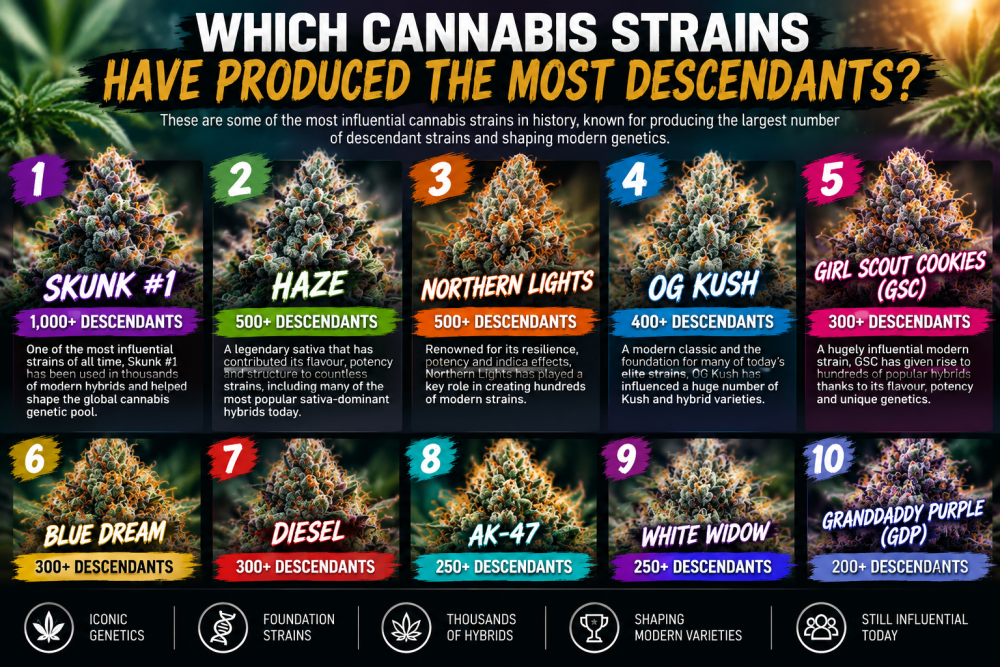
Cannabis Seeds: Which Cannabis Strains Have Produced the Most Descendants?
Of those, Skunk #1 has one of the strongest claims to being among the most influential parent lines in modern cannabis history. Modern genealogy databases record enormous family trees around it, although exact descendant counts depend on how a database defines a strain, breeder version and indirect descendant. Prime Cuts Nursery
This helps explain something customers often notice when browsing Discount Cannabis Seeds: there may be thousands of different cannabis strain names, yet start tracing their family trees and the same influential ancestors keep appearing.
The modern cannabis seeds catalogue is much less like thousands of completely separate families and much more like one enormous, interconnected genetic tree.
Can We Actually Know Which Cannabis Strain Has the Most Descendants?
Not with absolute certainty.
Cannabis doesn't have a universal pedigree registry recording every cross ever made.
For decades, breeders worked privately, genetics moved between countries, clones changed hands, breeding records were lost and the same genetics sometimes appeared under different names.
There is also the question of what counts as a descendant.
- Should we count only a strain's immediate children?
- What about grandchildren?
- Great-grandchildren?
- What if the same genetics appear several times in one family tree?
- What about two breeders producing different strains with the same name?
These questions make claims such as "this strain has exactly 4,732 descendants" much less reliable than they initially sound.
Genealogy databases can still be extremely useful for showing influence, but their totals shouldn't be mistaken for a complete census of every cannabis strain ever produced.
So rather than inventing a definitive top-ten ranking, it's more useful to look at the genetic families that repeatedly appear throughout modern cannabis ancestry.
Is Skunk #1 the Most Influential Cannabis Strain Ever?
It has one of the strongest claims.
Skunk #1 emerged from Californian breeding work associated with Sacred Seeds and Sam the Skunkman during the 1970s.
Its commonly reported ancestry combines Afghani, Colombian and Mexican/Acapulco Gold genetics, although—as with much early cannabis history—some details remain disputed. Budlabz
What made Skunk #1 particularly important wasn't simply its ancestry.
It became useful breeding material.
Once Skunk #1 reached Europe, it became deeply embedded within the emerging Dutch cannabis seed industry.
- Breeders crossed it with other important genetics.
- Those descendants were then used for further breeding.
- And the family tree exploded.
How Many Strains Descend From Skunk #1?
This illustrates why exact numbers need caution.
One modern genealogy source, Origenetica, currently associates Skunk #1 with more than 12,000 total descendants in its database. However, the same source explicitly labels aspects of the underlying historical record as unverified. Origenetica
- Another database may count them differently.
- Some will combine breeder versions.
- Others separate them.
- Some count indirect descendants several generations removed.
- The number itself therefore isn't the important part.
- The scale is.
Skunk #1's ancestry appears across an extraordinary number of subsequent cannabis breeding projects.
Which Famous Strains Are Connected to Skunk #1?
The direct and extended Skunk family became enormous.
Well-known examples associated with Skunk breeding include genetics such as:
and numerous later Skunk hybrids. Prime Cuts Nursery
And this demonstrates how descendant numbers multiply.
Suppose an influential strain contains Skunk #1.
That new strain becomes famous.
Twenty breeders then use that strain.
Their offspring subsequently become parents themselves.
Skunk #1 can eventually sit four, five or six generations behind a modern cannabis strain whose name contains no reference to Skunk whatsoever.
That's how one genetic line can influence thousands of later strains.
Cheese Is an Interesting Example.
UK Cheese demonstrates that a descendant doesn't necessarily begin with an intentional new cross.
The famous Cheese line is generally associated with an unusual selection from Skunk #1 genetics that was preserved as a clone in Britain.
That selection subsequently became influential in its own right. Strains
Once Cheese was used in further crosses, another genetic branch developed.
So you can have:
Skunk #1
↓
Cheese
↓
Cheese hybrids
↓
Descendants of those hybrids
The further down the tree you travel, the less obvious the original Skunk connection becomes.
For customers researching classic genetics at Discount Cannabis Seeds, this is why reading the stated lineage can reveal much more than looking at the strain name alone.
Is Original Haze Another Huge Cannabis Family?
Absolutely.
Original Haze is another foundational cannabis genetic family whose influence extends far beyond strains carrying "Haze" in their names.
Its early history is complicated and sometimes disputed, but Haze genetics became hugely important after being incorporated into European breeding programmes.
Modern genealogy databases show numerous direct Original Haze descendants, but its greater significance comes through the descendants of those descendants. SeedFinder.eu
This produced something similar to Skunk:
- A famous genetic line became a parent.
- Its offspring became famous.
- Those offspring then became parents.
- The Haze family spread.
Which Famous Cannabis Strains Descend From Haze?
Some extremely influential cannabis genetics have Haze ancestry.
Different branches include strains associated with:
The precise ancestry of individual products should always be checked against the breeder responsible for them, because not every strain using "Haze" in its name represents the same lineage.
But genealogically, Original Haze became one of the great foundation families of modern cannabis breeding.
This is another reason Discount Cannabis Seeds carries so many apparently different products whose ancestry eventually reconnects.
Northern Lights Created Another Enormous Family.
Northern Lights is another name that appears repeatedly when researching classic cannabis ancestry.
Its history isn't perfectly documented, and different numbered selections became particularly important.
Northern Lights #5 was especially influential as breeding material.
When breeders combined Northern Lights with other major genetic families, some of the resulting hybrids became legendary in their own right.
One of the most historically important combinations was:
Northern Lights #5 × Haze
That cross subsequently became associated with a substantial family of Haze hybrids. Historical accounts credit Nevil Schoenmakers with making the influential NL#5 × Haze combination during the late 1980s. Leafly
Now something important starts happening.
The big families begin crossing with each other.
What Happens When Two Huge Cannabis Families Are Crossed?
Their family trees merge.
This is one of the biggest reasons modern cannabis genetics are so interconnected.
Imagine:
Skunk family × Haze family
Then:
Northern Lights family × Haze family
Then a descendant containing those genetics gets crossed with something else containing Skunk.
Suddenly one modern strain can carry ancestry from several of the most influential cannabis families simultaneously.
This happened repeatedly.
It's why trying to divide modern cannabis neatly into completely separate genetic families becomes increasingly difficult.
Jack Herer Shows How Genetic Families Merge.
Jack Herer is an excellent historical example because its reported ancestry brings together several major genetic families.
Sensi Seeds' famous strain is generally associated with combinations involving Haze, Northern Lights and Skunk genetics.
That means three enormously influential breeding families converge in one strain.
Then Jack Herer itself became famous.
Other breeders subsequently worked with Jack-related genetics.
Now the family tree expands again.
A modern Jack descendant can therefore carry genetic influence from several important historic lines through a single parent.
What About Afghani Cannabis Genetics?
If we're talking about influence rather than individual commercial strain names, Afghani genetics arguably belong even deeper in the family tree.
Afghanistan is associated with some of the foundational broad-leaf cannabis populations incorporated into modern hybrid breeding.
Afghani genetics contributed to Skunk-related breeding.
They contributed to numerous hash-plant and indica-associated lines.
And those descendants subsequently entered countless further hybrids.
So depending on how you define "strain", an old geographical population such as Afghani could ultimately have a broader genetic footprint than any modern branded cultivar.
That's why this question doesn't really have one mathematical winner.
The further backwards we travel, the more we move from named commercial strains towards older regional populations.
The Same Is True of Colombian and Mexican Genetics.
Remember Skunk #1's ancestry.
Its historical pedigree incorporates Colombian and Mexican genetic material alongside Afghani ancestry. SeedFinder.eu
If Skunk #1 subsequently appears in thousands of later pedigrees, then its earlier ancestors indirectly appear within those pedigrees too.
Original Haze similarly emerged from older imported genetic material.
So the oldest and most influential cannabis family tree doesn't really begin with:
Skunk #1
or:
Original Haze
Those are important commercial breeding milestones.
Behind them are older geographical cannabis populations that supplied the genetic building blocks.
Did Blueberry Produce Lots of Descendants Too?
Yes.
Blueberry became another extremely influential breeding family.
Its importance illustrates a slightly different route to genetic success.
A strain doesn't need to dominate the entire cannabis industry to create a large family.
If breeders particularly value a genetic line, it can repeatedly appear in carefully selected hybrids.
Those descendants can then establish families of their own.
Blueberry ancestry became associated with numerous subsequent fruit-influenced hybrids and also intersected with other major genetic families.
A famous example is the Blueberry/Haze combination associated with Blue Dream.
Once again:
- Two established families meet.
- The offspring becomes famous.
- The offspring then creates descendants.
What About White Widow?
White Widow became another hugely recognisable 1990s genetic name.
Its exact history is more controversial than many simplified strain descriptions suggest, with competing accounts surrounding the original breeding material and people responsible for its creation.
But its commercial influence is undeniable.
White Widow-related crosses subsequently appeared across numerous breeder catalogues.
The name itself also became so commercially valuable that different versions emerged.
This creates an important distinction:
A large number of strains using a famous name doesn't necessarily mean every one is a verified genetic descendant of the original.
That's something we repeatedly emphasise at Discount Cannabis Seeds when discussing cannabis genetics.
Names and pedigrees aren't the same thing.
What About OG Kush?
Now we reach a later generation of influential genetics.
OG Kush became one of the foundations of modern American cannabis breeding.
Its exact origin remains famously disputed, which makes its family tree more difficult to document than something developed within a seed company with detailed breeding records.
But OG-related genetics subsequently became extraordinarily influential.
Numerous famous American strains contain OG-associated ancestry.
Those descendants were crossed again.
And by the 2000s and 2010s, Kush and OG-related names had spread internationally.
This was an important change in the cannabis seed market.
The huge Dutch genetic families of the previous era were now increasingly mixing with influential American lines.
Then Came Cookies.
If Skunk #1 represents one of the great foundational families of the old-school era, Girl Scout Cookies—often shortened to GSC or Cookies—represents one of the clearest examples of a modern genetic dynasty.
Cookies-related genetics became enormously fashionable.
Breeders used them repeatedly.
But the really important part came next.
Some Cookies descendants became even bigger breeding parents themselves.
This produced a genetic chain:
Cookies
↓
major Cookies descendants
↓
descendants of those descendants
↓
hundreds of newer crosses
That's how a strain family can explode within only a decade or two.
Gelato Made the Cookies Family Even Bigger.
Gelato is commonly associated with Sunset Sherbet × Thin Mint GSC.
Sunset Sherbet itself has Cookies ancestry, meaning Gelato is particularly deeply connected to the Cookies family. Prime Cuts Nursery
Gelato then became an enormously influential breeding parent.
Breeders crossed Gelato-related genetics with numerous other families.
Those offspring received new names.
Some became famous.
And those famous descendants were crossed again.
So a strain released years after the original Cookies era might have no Cookies-related word in its name while still carrying that ancestry.
Then Runtz Created Another Branch.
Runtz is another example of how quickly modern genetic families can expand.
Once a newer strain becomes commercially successful, breeders begin exploring its genetic potential.
New Runtz crosses appear.
Selections appear.
Related names appear.
Those strains then become parents.
Within a surprisingly short period, something that started as one modern genetic combination can become a family containing a huge number of products.
This process is much faster today because cannabis genetics move internationally far more quickly than they did during the 1970s or 1980s.
Why Do Successful Strains Produce So Many Descendants?
Because breeders aren't choosing parents randomly.
Successful genetics attract attention.
A famous strain already has:
- Recognition.
- An established genetic identity.
- Commercial interest.
- Characteristics breeders may want to combine with another line.
- That makes it attractive breeding material.
Once several breeders begin working with the same genetic family, the number of descendants can increase rapidly.
If even one of those descendants becomes another major success, the process accelerates.
Are Modern Cannabis Strains Basically All Related?
Not literally all of them, but modern commercial cannabis has undergone enormous hybridisation.
The boundaries between families have become increasingly complicated because major genetic lines have repeatedly been crossed together.
A strain might contain:
- An old Afghani ancestor.
- A Skunk-related branch.
- An American OG-associated parent.
- And a more recent Cookies-family descendant.
- All within one pedigree.
That's why our previous Discount Cannabis Seeds article asking Why Are So Many Modern Cannabis Strains Related to Each Other? connects directly with this question.
The answer is largely that successful cannabis genetics don't stop at one strain.
They become parents.
Can Two Modern Strains Share Several Ancestors?
Yes.
And this happens more often as breeding families become increasingly interconnected.
Imagine two apparently unrelated modern strains.
Trace them backwards and both might contain Gelato ancestry.
Trace Gelato backwards and Cookies appears.
Trace other parts of their pedigrees and another shared genetic family might appear.
So the two strains could share more than one historical ancestor.
This is why cannabis family trees can start resembling webs rather than traditional trees.
Does Having the Same Ancestor Make Two Strains the Same?
No.
This is extremely important.
Humans can share ancestors without being identical, and cannabis genetics work similarly in that broad sense.
A strain with Skunk #1 several generations back isn't simply Skunk #1.
A strain with Cookies ancestry isn't automatically Cookies.
Each additional cross introduces new genetic material.
Breeder selection matters.
The particular parent material matters.
Generations matter.
Two cannabis strains can therefore be related while remaining meaningfully different genetic lines.
Why Doesn't the Strain Name Tell Me This?
Because cannabis strain names aren't designed to function as complete pedigrees.
Imagine naming every modern strain after all of its ancestors.
Within several generations you'd have an absurdly long product name.
Instead, breeders create a new name.
That means ancestry disappears from the front of the packet.
A completely modern-sounding strain can contain genetics developed decades earlier.
When browsing cannabis seeds at Discount Cannabis Seeds, checking the breeder's stated parentage can therefore reveal connections that aren't visible from the product name.
Are Famous Strain Names Always Reliable Evidence of Ancestry?
No.
- This is where historical cannabis research becomes difficult.
- Names have been reused.
- Similar names have appeared independently.
- Famous genetics have been recreated.
- Breeders sometimes disagree about lineage.
- Old records can be incomplete.
- And different selections of a genetic family can diverge substantially over time.
That's why this article deliberately says strains such as Skunk #1 are among the most influential, rather than claiming we can scientifically crown one strain as having precisely the greatest number of descendants in history.
Cannabis genealogy simply isn't documented comprehensively enough to make that claim with certainty.
Which Cannabis Strains Are Among the Most Influential Parents?
If we concentrate on major genetic families rather than pretending we have a perfect numerical league table, several stand out:
Influential genetics
Why the family matters
Skunk #1
Foundation of a vast number of old-school and modern hybrids
Original Haze
Major ancestor of numerous Haze and Haze-hybrid families
Northern Lights
Particularly influential through NL selections and Haze/Skunk combinations
Afghani genetics
Foundational ancestry behind numerous classic hybrids
Blueberry
Important parent behind multiple fruit-related and hybrid families
White Widow
Major 1990s genetic name subsequently used in many crosses
OG Kush
One of the foundations of modern American hybrid breeding
Cookies/GSC
Created an enormous modern genetic family
Gelato
Cookies-family descendant that became a major parent itself
Runtz
More recent example of a successful strain rapidly producing a large family
This isn't a ranking from first to tenth.
It is a map of some of the genetic families whose influence repeatedly appears when researching modern cannabis ancestry.
Which One Has the Strongest Claim to Number One?
If you force the question down to one named commercial hybrid, I'd put Skunk #1 among the strongest candidates.
Its age gives it an enormous advantage.
It became internationally influential relatively early in the modern cannabis seed industry.
It entered European breeding programmes.
It was crossed extensively.
Some of those crosses became legendary strains themselves.
Those strains then produced further generations.
And modern genealogy databases consequently show an enormous extended Skunk #1 family. Prime Cuts Nursery
But if you include older geographical genetic populations, the answer becomes much harder.
Afghani, Colombian, Mexican and other older populations sit behind some of the very strains we're calling "foundational".
There is always another branch further back.
Could Cookies Eventually Overtake Skunk #1?
That's an interesting question.
Possibly in terms of documented modern commercial crosses, but there is no reliable global dataset that would allow us to determine when—or whether—that happened.
Cookies genetics have spread extraordinarily quickly.
And descendants such as Gelato have themselves become major parents.
That creates exponential growth.
Skunk #1, however, has had several additional decades for its genetics to spread through successive generations.
The two families also aren't necessarily completely separate once enough modern hybridisation occurs.
Eventually, a modern strain could contain both.
That's the problem with trying to turn cannabis genealogy into a simple competition.
What Will Produce the Next Huge Cannabis Genetic Family?
History suggests it won't necessarily be the newest strain.
It will be the strain whose genetics breeders continue using.
Popularity helps.
But breeding influence is measured by what comes afterwards.
A strain can be enormously fashionable for two years and leave relatively little long-term genetic impact.
Another might quietly become a favourite breeding parent and appear in hundreds of future pedigrees.
We therefore won't know which of today's newest cannabis genetics are truly historically important until years later.
Can You Explore These Genetic Families at Discount Cannabis Seeds?
Yes, and this is where understanding ancestry makes browsing a large cannabis seeds catalogue much more interesting.
Discount Cannabis Seeds brings together cannabis seeds from numerous established and modern breeders, allowing collectors to explore different branches of the same wider genetic families.
Rather than looking only for one famous name, you can compare:
- Original breeder genetics.
- Modern descendants.
- Feminised versions.
- Autoflower interpretations.
- New crosses involving established genetic families.
- Exclusive DCS cannabis seeds.
You may begin with one familiar strain and discover that several apparently unrelated products share parts of its ancestry.
Why Does This Matter When Choosing Cannabis Seeds?
Because lineage gives you information that branding alone cannot.
A new strain name tells you what the breeder decided to call the product.
Its family tree tells you where it came from.
When comparing cannabis seeds at Discount Cannabis Seeds, look at the strain name—but also look at the breeder and stated parents.
You might discover that a brand-new release contains genetics from a family you've been seeing for years.
Or that two products with completely different names are actually relatives.
That's one of the most fascinating parts of modern cannabis genetics.
Which Cannabis Strains Have Produced the Most Descendants?
There isn't an authoritative global ranking, so claims that one strain has an exact number of descendants should be treated cautiously.
But historically, several families stand above most others for their influence.
Skunk #1 is one of the strongest candidates for the most influential named hybrid, with an enormous genetic footprint stretching through decades of cannabis breeding. Origenetica
Original Haze and Northern Lights helped establish other enormous branches of the modern family tree.
Older Afghani and other geographical populations sit behind many of those foundation strains.
Later, OG Kush became hugely influential within American genetics.
Then Cookies produced another modern dynasty.
Its descendants—including Gelato—became major parents themselves.
And newer families such as Runtz demonstrate that the process is still happening.
Explore Cannabis Genetics at Discount Cannabis Seeds
The modern cannabis seeds market contains thousands of names, but underneath them sits a surprisingly interconnected genetic history.
At Discount Cannabis Seeds, collectors can explore cannabis seeds from established international breeders alongside modern genetic companies and exclusive DCS genetics.
When you're browsing, try looking beyond the newest strain name.
- Find its parents.
- Then find their parents.
- Follow the family backwards.
You may start with a modern release and eventually arrive at Cookies, OG Kush, Northern Lights, Haze, Skunk #1—or genetic populations whose histories stretch back much further.
And that's perhaps the most interesting thing about cannabis breeding:
The most influential strains don't simply become famous. They become ancestors.