




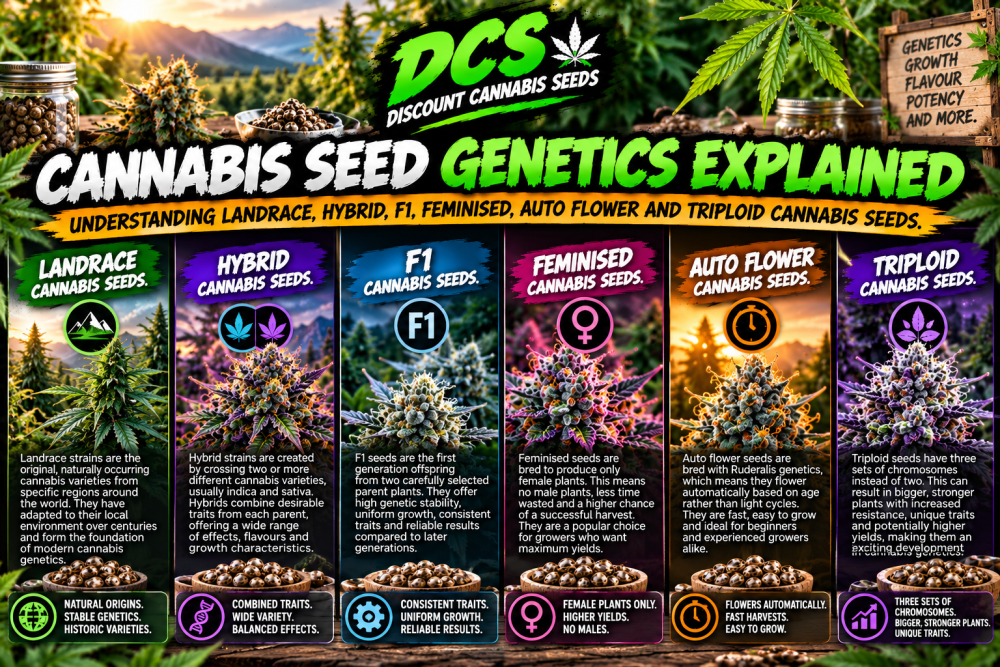
Cannabis Seeds Genetics Explained: Understanding Landrace, Hybrid, F1, Feminised, Auto Flower and Triploid Cannabis Seeds.
Cannabis genetics are at the heart of every cannabis seeds variety available today. From traditional landrace strains that developed naturally over generations to modern F1 hybrids and innovative triploid cannabis seeds, the cannabis seed industry has undergone significant changes through breeding, genetic research and selective development.
For anyone exploring cannabis seeds, understanding genetics is one of the most useful ways to recognise the differences between varieties. Two cannabis seeds may look almost identical, yet their genetic backgrounds, breeding histories and inherited characteristics can be very different.
At Discount Cannabis Seeds, we offer a diverse collection of cannabis genetics, including established seed bank varieties, exclusive DCS genetics, feminised cannabis seeds, auto flower cannabis seeds, triploid varieties and bulk cannabis seeds.
But what do all these terms actually mean?
What is the difference between a landrace cannabis strain and a modern hybrid? Are F1 cannabis seeds genetically different from ordinary hybrids? What makes triploid cannabis seeds unusual? And why can two seed banks offer varieties with the same name but different genetic characteristics?
This comprehensive guide explores the science, history and terminology behind cannabis seed genetics, helping collectors understand the genetic diversity found throughout the modern cannabis seed market.
What Are Cannabis Seed Genetics.
Cannabis seed genetics refers to the inherited biological information contained within a cannabis seed.
Like other plants, cannabis receives genetic material from its parent plants. This information influences characteristics such as plant structure, development, pigmentation, flowering behaviour and the potential to produce different chemical compounds.
Cannabis genetics are encoded within DNA, which is organised into chromosomes.
Most conventional cannabis plants are diploid, meaning their cells generally contain two sets of chromosomes.
However, cannabis genetics are more complex than simply inheriting one characteristic from each parent.
Many traits are influenced by multiple genes, while environmental conditions can also affect how inherited characteristics are expressed.
This explains why two plants belonging to the same named cannabis variety may not always display identical characteristics.
Understanding this relationship between genetics and observable traits is essential when comparing cannabis seed varieties.
Why Cannabis Genetics Matter.
Genetics provide the biological foundation for the characteristics associated with different cannabis varieties.
Breeders use inherited traits to develop new genetic lines, preserve established varieties and explore different combinations of characteristics.
For cannabis seed collectors, genetics also provide an important connection to the history of cannabis breeding.
A variety associated with traditional Afghan genetics may have a very different breeding background from a modern American hybrid or a European Haze-influenced strain.
Although names and marketing descriptions can provide useful information, they do not always tell the complete genetic story.
This is why understanding genetic classifications can be more informative than relying on strain names alone.
The History and Evolution of Cannabis Genetics.
Cannabis has a long history of human use and cultivation across different geographical regions.
Over many generations, cannabis populations developed through a combination of natural selection, human selection, migration and genetic exchange.
Different populations became associated with regions such as Central Asia, South Asia and other parts of the world.
As cannabis spread geographically, breeders and growers began combining different populations and selecting plants with particular characteristics.
During the twentieth century, international cannabis breeding expanded considerably.
Genetics associated with regions such as Afghanistan, Thailand, Colombia and Mexico contributed to the development of numerous modern cannabis hybrids.
The emergence of established breeding names such as Skunk, Northern Lights and Haze helped shape the commercial cannabis seed industry.
Today, modern cannabis breeding includes conventional hybridisation, molecular research, chromosome analysis and increasingly specialised genetic classifications.
The result is a cannabis seed market containing a mixture of historic genetic families and contemporary breeding developments.
What Are Landrace Cannabis Seeds.
Landrace cannabis refers to traditional cannabis populations associated with particular geographical regions.
These populations developed over many generations under local environmental conditions, often with varying degrees of human influence.
Unlike modern commercial hybrids, landrace populations are generally associated with a longer history within a particular region.
However, the term landrace does not necessarily mean that a population is genetically pure, unchanged or completely isolated.
Human movement and historical seed exchange have influenced cannabis populations for centuries.
Examples of Traditional Cannabis Genetic Regions.
Afghanistan.
Afghan cannabis populations have historically been associated with broad-leaf drug-type cannabis and have contributed to numerous modern hybrid lineages.
Thailand.
Traditional Thai cannabis populations are frequently referenced in discussions of narrow-leaf cannabis genetics and historic international breeding.
Colombia.
Colombian cannabis genetics played a role in the development of several influential cannabis breeding families.
Mexico.
Mexican cannabis populations contributed genetic material to a range of historic hybrid lines.
Hindu Kush Region.
Cannabis populations associated with the Hindu Kush region have influenced many well-known modern cannabis varieties.
Why Are Landrace Cannabis Genetics Important.
Landrace populations can contain genetic diversity that may be useful for scientific research and conservation.
They also provide insight into how cannabis populations developed across different environments and historical periods.
Preserving accurately documented genetic material is important because commercial breeding and changes in agriculture can reduce the availability of some traditional populations.
For cannabis seed collectors, landrace genetics represent an important part of cannabis history.
Understanding Indica, Sativa and Hybrid Cannabis Genetics.
Indica, sativa and hybrid are among the most recognisable terms in the cannabis seed industry.
However, their meanings are often more complicated than modern marketing descriptions suggest.
Historically, these terms have been used in botanical classification and to describe differences in plant appearance or geographical associations.
In the commercial cannabis market, they are also used to describe broad categories of strain heritage.
What Are Indica Cannabis Genetics.
The term indica is commonly associated in modern cannabis marketing with broad-leaf cannabis varieties and genetic families connected to regions such as Afghanistan.
However, commercial indica classifications do not provide a complete or consistently reliable description of a variety's genetic composition.
What Are Sativa Cannabis Genetics.
Sativa is commonly used in the cannabis industry to describe varieties associated with narrow-leaf cannabis traditions.
The botanical history of Cannabis sativa is more complex than this simplified commercial definition.
A variety labelled sativa may contain ancestry from several different genetic populations.
What Are Hybrid Cannabis Genetics.
Hybrid cannabis genetics result from the combination of different breeding lines.
Many modern cannabis varieties are hybrids, even when marketed as predominantly indica or sativa.
The terms indica-dominant and sativa-dominant are often used as broad commercial descriptions rather than precise measurements of genetic ancestry.
Are Indica and Sativa Reliable Indicators of Genetics.
Not always.
Research into commercial cannabis varieties has demonstrated that commonly used strain classifications do not consistently correspond to distinct genetic groups.
This means that strain labels should be interpreted alongside available breeder information rather than treated as definitive scientific descriptions.
What Are Hybrid Cannabis Seeds.
Hybrid cannabis seeds originate from crosses between different genetic lines.
Hybridisation is one of the foundations of modern cannabis breeding and has contributed to the development of many familiar strain families.
A hybrid may combine ancestry from different geographical populations, established commercial strains or selected breeding lines.
However, not every hybrid has the same level of genetic uniformity.
The consistency of a hybrid population depends partly on its parental genetics, breeding history and the methods used to produce the seeds.
Examples of Well-Known Hybrid Cannabis Families.
Bruce Banner is commonly associated with OG Kush and Strawberry Diesel ancestry.
Stardawg belongs to a genetic family associated with Chemdawg-related breeding.
Wedding Cake is commonly linked to modern American hybrid genetics, although lineage descriptions may vary between sources.
Gorilla Zkittlez is a modern hybrid name associated with Gorilla and Zkittlez genetic families.
These names demonstrate the diversity of genetic combinations found in contemporary cannabis seed collections.
What Are F1 Hybrid Cannabis Seeds.
F1 stands for first filial generation.
In genetics, the term refers to the first generation of offspring produced by crossing two parental lines.
In formal plant breeding, F1 hybrids are often produced using carefully developed parent lines selected for particular characteristics.
When genetically uniform parental lines are crossed, their F1 offspring can display a relatively consistent combination of inherited traits.
However, the term F1 alone does not guarantee that every seed will be genetically identical or that every characteristic will be uniform.
The genetic composition of the parent lines is an important factor.
What Is Hybrid Vigour.
Hybrid vigour, also known as heterosis, describes situations where hybrid offspring demonstrate improved performance in particular measurable traits compared with their parents.
This phenomenon has been studied extensively in agricultural plant breeding.
However, hybrid vigour is not guaranteed in every cross or for every characteristic.
The expression of heterosis depends on the parental genetics and the trait being evaluated.
Are All Hybrid Cannabis Seeds F1 Hybrids.
No.
Although every first-generation cross can be described genealogically as an F1 generation, the commercial term F1 hybrid is often used more specifically for crosses involving developed parental lines.
Ordinary hybrid cannabis seeds may originate from breeding populations with different levels of genetic uniformity.
This distinction is important when comparing seed bank descriptions.
F1 Hybrid Cannabis Seeds vs Traditional Hybrid Cannabis Seeds.
Feature
F1 Hybrid Cannabis Seeds
Traditional Hybrid Cannabis Seeds
Genetic origin
First-generation cross
Crosses involving different genetic lines
Parent lines
May involve developed, uniform lines
Parent uniformity varies
Uniformity
Can be relatively high with suitable parents
Depends on breeding history
Hybrid vigour
May occur
May also occur
Genetic diversity
Depends on parental genetics
Depends on parental genetics
Breeding terminology
Specific generational designation
Broad genetic classification
The key difference is not simply whether a seed is a hybrid, but how its parental lines were developed and documented.
What Are Feminised Cannabis Seeds.
Feminised cannabis seeds are produced using breeding techniques intended to increase the proportion of female offspring.
Cannabis is commonly dioecious, meaning individual plants generally develop male or female reproductive structures.
In conventional seed production, genetic sex determination influences the proportion of male and female offspring.
Feminised seed production uses the reproductive biology of cannabis to produce seeds with a high likelihood of developing into female plants.
However, feminised does not mean that every seed is guaranteed to produce a female plant under all circumstances.
Are Feminised Cannabis Seeds Genetically Different.
Feminised seeds are not a separate species or a completely distinct genetic family.
The term describes a seed production category.
A feminised seed may belong to a traditional hybrid, a modern commercial strain or another breeding line.
This means that feminised cannabis seeds can carry many different genetic backgrounds.
Are Feminised Seeds the Same as F1 Seeds.
No.
Feminised describes the intended sex distribution of the offspring.
F1 describes the generation produced from a cross.
A seed can potentially be both feminised and F1 because the terms describe different aspects of its origin.
What Are Auto Flower Cannabis Seeds.
Auto flower cannabis seeds are associated with genetic characteristics that allow flowering to begin with less dependence on seasonal changes in day length.
This differs from traditional photoperiod cannabis varieties, where flowering is strongly influenced by the duration of light and darkness.
Auto flower genetics are historically associated with Cannabis ruderalis and related populations.
Over time, auto flower characteristics have been incorporated into numerous modern cannabis breeding families.
Today, auto flower cannabis seeds are available under many familiar strain names.
Understanding Ruderalis Genetics.
Cannabis ruderalis has historically been used to describe cannabis populations associated with particular geographical regions and flowering characteristics.
Its exact taxonomic status remains debated.
In the commercial cannabis seed industry, ruderalis is frequently referenced because of its association with automatic flowering behaviour.
However, modern auto flower varieties may have complex genetic backgrounds involving several breeding lines.
Examples of DCS Auto Flower Cannabis Seeds.
The Discount Cannabis Seeds collection includes several varieties within the auto flower category.
Associated with the familiar Amnesia and Haze genetic family.
Connected by name to the modern Stardawg and Chemdawg-related family.
Part of the DCS exclusive auto flower collection.
A variety offered within our own DCS auto flower range.
Associated with the modern Gorilla Cookies strain family.
These varieties demonstrate how auto flower classifications can be combined with different genetic identities.
Auto Flower vs Feminised Cannabis Seeds: What Is the Difference.
One of the most common misunderstandings in the cannabis seed market is that auto flower and feminised seeds are opposite categories.
In reality, they describe different characteristics.
Auto flower refers to flowering behaviour.
Feminised refers to the intended sex distribution of the offspring.
A cannabis seed can therefore be both auto flower and feminised.
Feature
Auto Flower Cannabis Seeds
Feminised Cannabis Seeds
Main classification
Flowering behaviour
Intended sex distribution
Genetic background
Includes automatic flowering genetics
Can include many genetic backgrounds
Photoperiod dependence
Reduced
Depends on whether auto flower or photoperiod
Female offspring
Depends on seed production
Intended to be predominantly female
Can overlap
Yes
Yes
Understanding these distinctions makes it easier to interpret cannabis seed product descriptions accurately.
What Are Triploid Cannabis Seeds.
Triploid cannabis seeds represent an increasingly discussed category within modern cannabis genetics.
The term triploid describes an organism whose cells generally contain three sets of chromosomes rather than the two sets typically found in diploid plants.
Chromosome number is an important part of plant genetics because it influences how genetic material is organised and inherited.
Triploidy occurs in numerous plant species and has been studied extensively in agricultural breeding.
Understanding Diploid and Triploid Genetics.
Most conventional cannabis plants are diploid.
This means their cells generally contain two sets of chromosomes.
Triploid plants contain three sets.
In cannabis, the standard diploid chromosome number is generally 20, while triploid plants typically contain 30 chromosomes.
This difference can affect chromosome pairing during reproduction.
Why Are Triploid Genetics Interesting.
Triploidy can influence fertility because three chromosome sets may not divide evenly during the formation of reproductive cells.
In some plant species, triploidy is associated with reduced fertility or seedlessness.
However, triploid does not automatically mean completely sterile.
The reproductive characteristics of triploid plants can vary depending on the species, genetic background and individual plant.
Are Triploid Cannabis Seeds Genetically Modified.
Triploidy does not automatically mean genetic modification through recombinant DNA or gene editing.
Changes in chromosome number can occur naturally in plants and can also be produced through breeding and chromosome-manipulation techniques.
Whether a particular product has been developed using a specific technique depends on its documented breeding history.
The term triploid describes chromosome-set number, not a single production method.
Understanding Polyploid Cannabis Genetics.
Polyploidy refers to the presence of more than two complete sets of chromosomes.
Triploidy is one example of polyploidy.
Tetraploid plants contain four chromosome sets.
Polyploidy is common in the plant kingdom and has played an important role in the evolution of numerous crop species.
Researchers investigate polyploidy because chromosome-set changes can influence reproductive biology, cellular characteristics and gene expression.
However, the effects vary considerably between species and genetic lines.
Diploid vs Triploid vs Tetraploid Cannabis Genetics.
Classification
Chromosome sets
Typical cannabis chromosome count
Main distinction
Diploid
Two
20
Conventional chromosome arrangement
Triploid
Three
30
Three chromosome sets
Tetraploid
Four
40
Four chromosome sets
These counts describe typical complete chromosome complements and do not rule out chromosomal abnormalities or variation in individual plants.
Exploring the DCS Triploid Cannabis Seeds Collection.
At Discount Cannabis Seeds, our triploid cannabis seed collection includes several distinctive varieties.
These include Triploid Amnesia, Frosted Guava, Zookies, Sherbet, Orange Runtz and Rotten Apple.
The collection brings together recognisable modern cannabis names within a chromosome-based genetic category.
Amnesia is one of the most recognisable names associated with European Haze-influenced cannabis genetics.
The triploid version places this established strain identity within a different chromosome classification.
Frosted Guava represents a modern cannabis strain name associated with contemporary hybrid breeding.
Its inclusion in the triploid collection demonstrates the range of genetic identities represented within this category.
Zookies is associated with modern American hybrid cannabis genetics.
The triploid designation refers to chromosome-set number rather than independently confirming a particular breeding lineage.
Sherbet is a recognised name within contemporary dessert-associated cannabis strain families.
The triploid version combines that strain identity with a different chromosome classification.
Orange Runtz is associated with modern Runtz-related cannabis genetics.
Its name reflects the influence of contemporary hybrid breeding on the cannabis seed market.
Rotten Apple is another distinctive variety within the DCS triploid collection.
As with all triploid cannabis seed products, chromosome classification and genetic characteristics should be assessed using product-specific documentation.
The DCS triploid range gives collectors an opportunity to explore a category of cannabis genetics that differs from conventional diploid classifications.
Are Triploid Cannabis Seeds Better Than Regular Cannabis Seeds.
Triploid cannabis seeds are not automatically superior to conventional diploid seeds.
Although triploidy can affect reproductive biology, the presence of three chromosome sets does not guarantee improved genetic quality or performance.
Different triploid lines may exhibit different characteristics.
The most reliable comparisons depend on documented genetics, chromosome verification and relevant research.
For collectors interested in emerging cannabis genetics, triploid varieties represent an additional category to understand rather than a universal replacement for conventional seeds.
What Is Genetic Stability in Cannabis Seeds.
Genetic stability is a term frequently used in cannabis seed descriptions.
However, it can refer to several different concepts.
In plant breeding, stability may describe the consistent expression of particular characteristics across generations or environments.
It may also refer to the maintenance of an established breeding line.
Genetic stability should not be confused with complete genetic uniformity.
A seed population can contain genetic variation while still expressing certain characteristics consistently.
Why Can Cannabis Seeds From the Same Strain Look Different.
Cannabis plants can inherit different combinations of genetic variants from their parents.
Even seeds produced from the same parental population may not be genetically identical.
Environmental conditions can also influence the expression of inherited traits.
This interaction between genetics and environment contributes to variation within plant populations.
What Is a Cannabis Phenotype.
A phenotype refers to the observable characteristics of an organism.
In cannabis, these can include plant structure, leaf shape, pigmentation and other measurable biological traits.
Phenotypes result from the interaction between genetic information and environmental influences.
Genotype vs Phenotype.
A genotype describes an organism's genetic makeup.
A phenotype describes the characteristics that are expressed.
Two plants may share a closely related genetic background but display different phenotypes under different environmental conditions.
Likewise, plants with different genotypes may sometimes display similar observable characteristics.
This distinction is important when interpreting strain descriptions and breeder information.
Why Can Two Cannabis Seed Banks Sell the Same Strain Name.
The cannabis seed industry contains many varieties associated with widely recognised names.
Examples include White Widow, Northern Lights, Amnesia Haze, Stardawg and Blue Cheese.
However, products carrying the same strain name are not necessarily genetically identical.
Different breeders may work with different parental selections, breeding populations or interpretations of an established strain family.
Some varieties have also developed complex commercial histories, making their precise ancestry difficult to verify independently.
Does the Same Strain Name Guarantee the Same Genetics.
No.
A shared strain name may indicate a claimed genetic family or historical association, but it does not guarantee identical DNA.
For this reason, customers should consider the breeder and product-specific information when comparing cannabis seeds from different suppliers.
Understanding Cannabis Seed Quality and Genetic Authenticity.
Genetic authenticity and seed quality are related but distinct considerations.
Genetic authenticity concerns whether a product corresponds to its stated genetic identity or documented breeding line.
Seed quality can involve physical condition, viability, purity and other measurable characteristics.
A seed can belong to a documented genetic line without necessarily meeting every quality expectation.
Similarly, a physically viable seed does not automatically have a verified genetic identity.
Important Considerations When Comparing Cannabis Seeds.
Breeder identification.
The breeder or supplier can provide useful context about the product's origin.
Genetic documentation.
Detailed lineage information may help clarify a variety's breeding background.
Seed classification.
Terms such as feminised, auto flower and triploid should be interpreted according to their specific meanings.
Product consistency.
Consistency claims are more meaningful when supported by appropriate evidence.
Accurate descriptions.
Product information should distinguish documented characteristics from general strain-family associations.
These factors can help collectors compare cannabis seeds beyond their names or packaging.
Bulk Cannabis Seeds and the Importance of Genetic Provenance.
Bulk cannabis seeds have become a prominent category within the wider cannabis seed market.
The term bulk generally refers to seeds sold in larger quantities rather than only in small branded retail packs.
However, bulk is a purchasing format, not a genetic classification.
Bulk cannabis seeds can belong to many different genetic families and seed categories.
Are Bulk Cannabis Seeds Different From Branded Cannabis Seeds.
Not necessarily.
The distinction between bulk and branded seeds often concerns packaging, quantity, distribution and commercial presentation.
Genetic characteristics depend on the actual seed line rather than whether the seeds are sold in a large or small pack.
What Is Genetic Provenance.
Genetic provenance refers to information about the origin and history of genetic material.
In the cannabis seed industry, provenance may involve the breeder, parental lineage, breeding programme or documented source.
Clear provenance can help distinguish between similarly named varieties.
However, not every commercial cannabis seed product provides the same level of genetic documentation.
Why DCS Offers Bulk Cannabis Seeds.
At Discount Cannabis Seeds, bulk cannabis seeds form an important part of our exclusive collection.
Our range includes familiar genetic names such as Stardawg, Bruce Banner, Purple Urkle and several auto flower varieties.
By offering selected varieties in larger quantities, we provide an additional purchasing option alongside conventional seed bank packs.
Customers can compare available quantities, product categories and pricing through our website.
Comparing the Main Types of Cannabis Seed Genetics.
The following table summarises the major classifications discussed throughout this guide.
Cannabis seed type
What the term describes
Main genetic distinction
Landrace
Traditional regional population
Historical geographical association
Hybrid
Cross between genetic lines
Combined ancestry
F1 hybrid
First filial generation
Specific generation from a cross
Feminised
Seed sex classification
Intended predominance of female offspring
Auto flower
Flowering behaviour
Reduced dependence on day length
Diploid
Chromosome classification
Two chromosome sets
Triploid
Chromosome classification
Three chromosome sets
Tetraploid
Chromosome classification
Four chromosome sets
Bulk cannabis seeds
Purchasing format
No specific genetic distinction
These classifications are not necessarily mutually exclusive.
For example, a cannabis seed may be feminised, auto flower and hybrid at the same time.
Understanding which characteristics each term describes helps prevent confusion when comparing cannabis seed products.
Common Misconceptions About Cannabis Seed Genetics.
Despite the amount of information available online, several misconceptions remain common.
All Cannabis Seeds With the Same Name Are Genetically Identical.
This is incorrect.
Different breeders may offer distinct selections under the same familiar strain name.
Feminised Cannabis Seeds Are a Separate Cannabis Species.
Feminised is a seed production classification, not a separate species.
Every F1 Hybrid Is Completely Uniform.
F1 offspring can show consistency when suitable parental lines are used, but the term alone does not guarantee complete uniformity.
Auto Flower Cannabis Seeds Cannot Be Feminised.
Auto flower and feminised describe different characteristics, so a seed can belong to both categories.
Triploid Cannabis Seeds Are Always Completely Sterile.
Triploidy can reduce fertility, but complete sterility is not guaranteed.
Bulk Cannabis Seeds Are Automatically Lower Quality.
Bulk describes the quantity or purchasing format and does not independently establish genetic quality.
Exclusive Cannabis Genetics Must Be Unique to One Retailer.
Exclusivity may refer to branding or distribution rather than a genetically unique lineage.
Recognising these differences makes cannabis seed terminology easier to understand.
How Cannabis Genetics Are Changing the Seed Industry.
The cannabis seed industry continues to develop as research and breeding knowledge expand.
Historically, many commercial cannabis varieties were identified primarily through strain names and descriptions of their observable characteristics.
Modern genetic research provides additional ways to investigate ancestry, genetic diversity and relationships between populations.
DNA-based analysis can help researchers study genetic similarities and differences that may not be apparent from appearance alone.
Chromosome research also contributes to the scientific understanding of diploid, triploid and other polyploid cannabis plants.
At the same time, the commercial market continues to introduce new strain names, genetic combinations and branded collections.
This creates opportunities for greater diversity, but it also makes accurate terminology increasingly important.
As the market develops, transparent genetic information will remain valuable for both researchers and cannabis seed collectors.
Why Shop With Discount Cannabis Seeds.
At Discount Cannabis Seeds, we believe that understanding cannabis genetics should be an important part of exploring the cannabis seed market.
Our website brings together established international cannabis seed banks and our own exclusive DCS collection, giving customers access to a broad selection of genetic families, classifications and product ranges.
Rather than focusing on one particular type of cannabis seed, our catalogue reflects the diversity of modern cannabis breeding.
Customers can explore historic genetic names, contemporary hybrids, feminised varieties, auto flower cannabis seeds and newer categories such as triploid genetics.
Our exclusive DCS collection includes familiar varieties such as Stardawg, Bruce Banner, Purple Urkle and Auto Amnesia, while our triploid range introduces an additional area of genetic interest.
We also recognise that customers compare more than strain names.
Product categories, pack quantities, genetic heritage and pricing all contribute to the information available when considering different cannabis seed products.
That is why our bulk cannabis seeds range sits alongside conventional branded seed bank packs, offering additional options within our wider collection.
Our aim is to make cannabis seed information easier to understand by explaining the terminology behind the products and exploring the history of the genetic families represented.
From established cannabis breeding traditions to developing areas of genetic research, Discount Cannabis Seeds provides a place to discover and compare the diversity of cannabis genetics available today.
Frequently Asked Questions About Cannabis Seed Genetics.
What Are Cannabis Seed Genetics.
Cannabis seed genetics refers to the inherited DNA that influences the biological characteristics of a cannabis plant. This genetic information comes from its parental lines and interacts with environmental factors to influence observable traits.
What Is the Difference Between Landrace and Hybrid Cannabis Seeds.
Landrace cannabis refers to traditional populations associated with particular geographical regions, while hybrid cannabis seeds result from crosses between different genetic lines.
Are F1 Cannabis Seeds Better Than Regular Hybrid Seeds.
Not necessarily. F1 describes a specific generation of offspring, and the characteristics of those seeds depend on the genetics and development of their parental lines.
What Is the Difference Between Feminised and Auto Flower Cannabis Seeds.
Feminised describes the intended sex distribution of the offspring, while auto flower describes flowering behaviour. A cannabis seed can be both feminised and auto flower.
What Are Triploid Cannabis Seeds.
Triploid cannabis seeds are associated with plants that generally contain three complete sets of chromosomes rather than the two sets found in conventional diploid plants.
Are Triploid Cannabis Seeds Genetically Modified.
Triploidy does not automatically mean that recombinant DNA technology or gene editing has been used. The term describes chromosome-set number, while production methods depend on the individual breeding programme.
What Is the Difference Between Diploid and Triploid Cannabis Genetics.
Diploid cannabis generally contains two chromosome sets, while triploid cannabis contains three. This difference can influence reproductive biology and chromosome behaviour.
Why Do Cannabis Strains Have Different Genetics Under the Same Name.
Different breeders may use different parental selections, breeding lines or genetic populations under the same commercial strain name. A shared name does not guarantee identical genetic composition.
What Does Genetic Stability Mean in Cannabis Seeds.
Genetic stability generally refers to the consistency of inherited characteristics or the maintenance of a breeding line. Its exact meaning depends on the context and how the characteristics are measured.
Are Bulk Cannabis Seeds Genetically Different.
Not inherently. Bulk refers to a purchasing format rather than a distinct genetic category. Genetic characteristics depend on the specific seed line.
What Is the Difference Between Genotype and Phenotype.
Genotype refers to an organism's genetic makeup, while phenotype refers to the observable characteristics resulting from interactions between genetics and environmental conditions.
What Are DCS Exclusive Cannabis Genetics.
DCS exclusive cannabis genetics are varieties offered under the Discount Cannabis Seeds collection. The range includes different cannabis genetic families, auto flower varieties, feminised options and selected bulk cannabis seeds.
Does Indica or Sativa Tell You the Exact Genetics of a Cannabis Seed.
No. These terms are often used as broad commercial classifications and do not reliably describe a variety's complete genetic ancestry.
What Is Hybrid Vigour in Cannabis Genetics.
Hybrid vigour, or heterosis, describes situations where hybrid offspring demonstrate improved performance in particular traits compared with their parents. It is not guaranteed in every hybrid cross.
Why Is Genetic Diversity Important in Cannabis.
Genetic diversity provides variation within and between cannabis populations. This variation is important for understanding evolutionary history, conserving genetic resources and studying inherited characteristics.
Conclusion: Understanding the Diversity Behind Cannabis Seeds.
Cannabis genetics are far more complex than the familiar strain names printed on seed packaging.
Behind every cannabis seed is a genetic background shaped by inheritance, breeding history and the biological processes that influence plant development.
Traditional landrace populations provide connections to the geographical and historical origins of cannabis diversity.
Modern hybrids demonstrate how different genetic lines have been combined over generations.
F1 hybrid terminology introduces an important distinction between general hybrid ancestry and specific breeding generations.
Feminised and auto flower classifications describe different biological characteristics, while triploid genetics introduce chromosome-based distinctions that are becoming increasingly prominent within the cannabis seed industry.
Understanding these differences allows cannabis seed collectors to look beyond marketing terminology and appreciate the wider genetic history associated with individual varieties.
It also explains why two products with the same strain name may not necessarily have identical genetics, why bulk cannabis seeds are not a separate genetic category and why accurate breeder information matters.
At Discount Cannabis Seeds, our collection reflects this diversity.
From established genetic names such as Stardawg and Bruce Banner to our exclusive auto flower varieties and DCS triploid collection, we bring together cannabis seeds associated with different breeding traditions and genetic classifications.
As scientific understanding continues to develop, the language used to describe cannabis genetics will become increasingly important.
For anyone researching cannabis seeds in the UK, understanding the difference between genetic heritage, seed classifications and commercial terminology provides a stronger foundation for comparing the varieties available.
Explore the exclusive DCS collection, triploid cannabis seeds, auto flower varieties and bulk cannabis seeds at www.discountcannabisseeds.co.uk.